

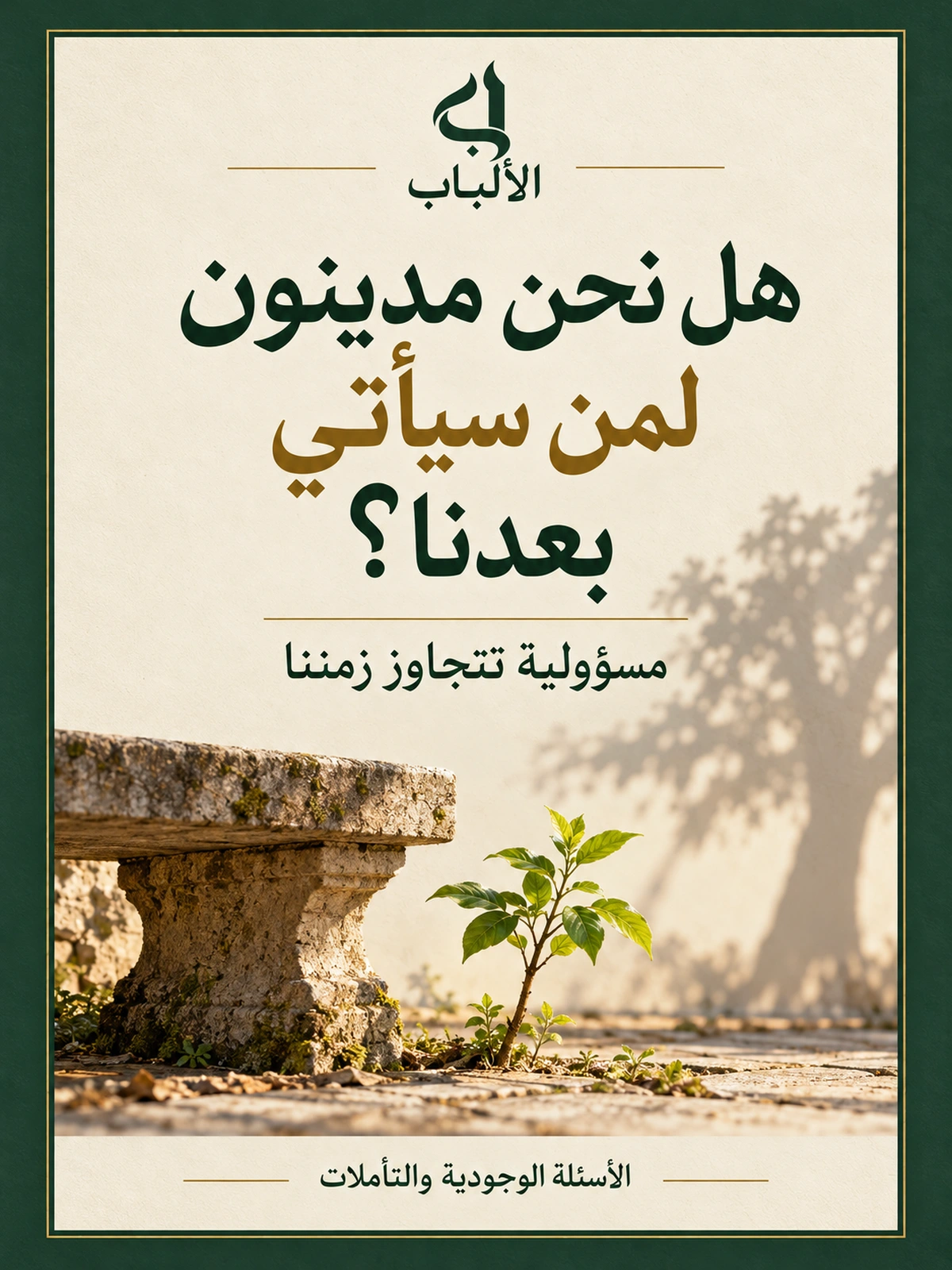
Shade from a tree we did not plant
This scene is imagined: a woman sits on a stone bench beneath a large tree in an old schoolyard. She does not know who planted it, or whether they ever sat in its shade. She has come to hand over her work to a new teacher, carrying papers whose arrangement only she understands. She could leave them as they are; her direct professional responsibility has ended. Instead, she spends another hour explaining files and recording what she learned from mistakes. This hardly looks like visible heroism. Yet a child who has not entered the school may one day benefit from that hour.
Tree and papers share one meaning: we live within traces others created, and leave conditions within which others will live. We choose some consciously; neglect and postponement create others. The question is not about making our names immortal, but about justice between time we possess now and time that will reach people we do not know.
Calling ourselves indebted to those who come after us does not necessarily mean a financial debt or specific legal obligation. It raises an ethical question: is an action’s usefulness to us today enough if its cost falls on people unable to object? Can we preserve the possibilities of their lives without imposing our preferred version of life?
Questions to open the reading
- Does future people’s absence from our sight limit our responsibility towards them?
- How can we preserve future options without imposing our choices?
- Who bears the cost of caring for tomorrow, and what share belongs to those in need today?
- What small legacy can we leave in a usable state?
1. People whose names we do not know
Responsibility towards a child we see or a neighbour whose complaint we hear comes readily. Someone not yet born has no face in our meeting and no voice in our discussion. This absence does not make our actions’ effects on them impossible, but makes ignoring them easier. A project may end in its creators’ accounts while its consequences remain in its successors’ lives. Postponing maintenance may look like saving money because the calculation never asks who later pays for failure.
This is not a psychological experimental finding offered here, but an entry into an ethical argument: a beneficiary’s visibility should not be the sole measure of their interests’ value. We already respect unknown people’s interests in everyday life; returning a library book intact does not require knowing the next reader’s name. Moving from an unknown reader to one arriving further in the future broadens the question without resolving all its difficulties.
“The needs and interests of present and future generations.” UNESCO, Declaration on the Responsibilities of the Present Generations Towards Future Generations, Article 1; English rendering of the Arabic excerpt. Original source
UNESCO’s 1997 declaration joins present and future, also addressing freedom of choice and preservation of the Earth. We invoke it as a normative ethical declaration without attributing a binding legal ruling to it here. It opens an important possibility: speaking of the future need not erase the present.
“Generations” can mislead if it makes us imagine two uniform masses. Enormous differences in capacity exist among people alive today, and unknown differences will exist among future people. Calling our generation responsible is not enough if demands are then distributed equally. Someone controlling far-reaching decisions faces a different question from someone securing daily necessities. Equal dignity does not mean equal capacity to act.
2. What we leave is different from what we own
We may inherit something and behave as though its story began with us. The land we use, knowledge we learned from, and institution giving our work meaning are not all our creations. This is simple fact, but its ethical consequence requires discussion: what limits apply to our right of use when an action’s effects outlast the user?
This does not forbid all change. Keeping a poor arrangement simply because it was inherited can be neglect dressed as loyalty. A school that never renews itself, or a procedure everyone knows is harmful, does not become good through age. Responsibility to future people sometimes requires reform, sometimes preservation, and sometimes admitting we do not yet know a sufficient solution.
One practical criterion for reflection is whether a decision increases successors’ capacity to understand and choose, or leaves a closed problem without tools to address it. This is no machine producing final answers, but distinguishes providing a resource from leaving a constraint. A good library lets readers disagree with its founder; one forbidding all disagreement may preserve the founder’s opinion more than serve readers’ knowledge.
Small matters reveal this too. Documenting reasons for a difficult decision lets successors reconsider it. Hiding a mistake to protect our image makes them begin with avoidable ignorance. We should not plan their lives for them: care can become guardianship if we assume gratitude requires them to continue down the same road.
I therefore see one of our finest legacies as a door that can open, rather than instructions fastening it shut. This is a reflective conclusion proposed by the article, not a borrowed definition or saying attributed to a sage. Its strength lies in testing our intentions: do we truly want future people’s benefit, or our own continuing presence in their decisions after we are gone?
3. Time reveals a decision’s cost
A decision may be easy because we count only immediate benefit. We see time saved by omitting explanations, but not time a colleague loses searching for meaning. We see a place’s opening ceremony without asking who will care for it when celebration ends. The beginning can look successful while continuity is left to chance.
This does not mean every work must last forever. Some work is inherently temporary and fulfils its purpose by serving a specific need. The problem is presenting the temporary as stable, or passing costs to others without making them visible. Honesty about a work’s limits is part of honesty in doing it.
It helps to distinguish repairable effects from those difficult to reverse. Without claiming to know the whole future, we can prefer, when options are otherwise similar, what leaves room for review. Limited trials and clear documentation may be fairer than a large rush turning guesses into hard-to-change realities. This is a general precautionary principle for thinking, not a technical recipe for every field.
Excessive fear of the future can nevertheless paralyse action. Waiting for complete certainty would prevent founding a school, writing a book, or raising a child. What is needed is responsibility under uncertainty: asking, consulting appropriate expertise, stating our estimates’ limits, and revisiting them when warranted. Good intentions do not guarantee results, but become serious through readiness to learn and correct.
4. An effect needing no signature
Talk of legacy sometimes concerns a wish to remain: a project bearing its creator’s name or a good reputation lasting beyond death. This is an understandable human wish, but benefit is not measured only by preserving a name. An anonymous contribution may matter more to its beneficiary than one surrounded by identifying plaques.
The school example reveals the distinction. A child may never know who wrote handover notes, yet receive a better service because of them. If their writer required every beneficiary to remember them, the action’s centre would change: the beneficiary would become a witness to the giver’s virtue instead of a person whose need is protected. This abolishes neither thanks nor recognition, but frees a work’s value from requiring gratitude.
“Whenever a bird, a person, or an animal eats from it, it counts as charity for him.” English rendering of an excerpt from Anas ibn Malik’s report from the Prophet Muhammad, peace and blessings be upon him, Sahih Muslim, hadith 1553a, on planting and sowing. Hadith text
The hadith concerns creatures benefiting from planting and sowing, and does not mention future generations in those words. Our reflection connects it more broadly than a literal correspondence: good can reach a beneficiary whom its maker did not choose and from whom they receive no return. This connection remains the article’s reflection, with the hadith retained in its meaning and context.
There is humility in serving a time we will not see. We work without observing the entire fruit, accepting that successors may develop or correct what we began. Perhaps a legacy succeeds when people no longer need its maker because the work is understandable and sustainable. An institution that moves only when one person is present raises questions about readiness for tomorrow, however sincere that person is.
In the light of the Quran and Islamic wisdom
TRANSLATION OF THE MEANING · COMPLETE VERSE 7:56Do not spread corruption on earth after it has been set aright, but call upon Him with fear and hope[1]. Indeed, the mercy of Allah is close to those who do good.Translation notes: [1] i.e., not to be too sure of oneself while supplicating, gloating over good deeds, or despairing of His Mercy.Rowwad Translation Center · QuranEnc · v1.0.20 The Holy Quran, Al-Araf 7:56; excerpt. The verse and Al-Saadi’s commentary
Al-Saadi explains the prohibition here as committing sins after reform through obedience, discussing corruption of character, deeds, and livelihoods. The verse should therefore not be reduced to a contemporary environmental programme or credited with detailed generational policies. Its text is broader; our connection is an ethical judgement about responsibility for an action’s effects, respecting the commentary’s meaning.
“Excellence in every act of worship means exerting effort in it.” English rendering of an excerpt from Abd al-Rahman al-Saadi’s commentary on Surat Al-Araf, verse 56. Source
Exerting effort returns us to present responsibility. A beautiful picture of the future is insufficient if it excuses neglecting a known duty today. Excellence in a small available task may be more sincere than expansive talk of saving unknown generations while neglecting the rights of people encountered every morning.
“Ongoing charity or knowledge from which people benefit.” English rendering of an excerpt from Abu Hurayrah’s report from the Prophet Muhammad, peace and blessings be upon him, Sahih Muslim, hadith 1631, on deeds continuing after death. Hadith text
The hadith names three avenues, also including a righteous child who prays for the person. The excerpt draws attention to charity’s and knowledge’s continuing benefit, without a worldly promise that every project will last or every cherished effect is necessarily good. Knowledge needs truthfulness, and benefit needs a reality people can use. Reflecting on this, a legacy’s goodness depends on what it offers, not simply its duration.
A serious objection: what about people in need today?
A reader may object: how can the present be asked to sacrifice for nonexistent people while people now need education, food, and safety? This matters because the banner of the future can conceal an unjust distribution of costs, asking the weakest to give up something while the strongest keep their privileges.
This article has no equation resolving every conflict, nor claims ethical reflection replaces examining facts. It rejects starting with the assumption that present rights obstruct tomorrow. The child whose education we protect today belongs to the future, and preserving a worker’s capacity for a dignified life is no luxury deferrable until a more prosperous age.
If a real trade-off appears, describe it clearly: who benefits, who bears costs, what alternatives exist, and who participates in deciding? When information is incomplete, acknowledging that is fairer than invoking future generations to silence objections. Absent people cannot authorise us, so speaking for them increases our need for humility and accountability.
Practical applications: handing on the world within reach
Practice can begin with one resource in our care. Choose a book, work file, shared garden, or knowledge acquired. Ask what condition it will be in when passed on, and what small piece of information might prevent a recurring mistake. Faithful handover does not require a large project.
In shared work, set aside time to document what has and has not been done, with decisions’ reasons and limits. Do not hide unfinished parts inside celebratory language. Record what needs maintenance, who can understand it, and where its materials are. Such details may say more than a long speech about sustainability.
At home, the question of inheritance can extend beyond things to how we deal with them: learning repair, distinguishing knowledge from rumour, and disagreeing without insult. These are educational examples for reflection, not a checklist guaranteeing particular outcomes. Values need practice permitting questions and correction, and consistency with how we live.
Finally, review the scale of a promise. A limited commitment you know how to fulfil is more useful than a sweeping promise concealing inability. If the matter exceeds your expertise or capacity, involve people with appropriate knowledge and responsibility. Honest distribution of work gives continuity a chance and prevents the future from becoming another name for exhausting one person.
Conclusion: leaving a possibility
We return to the woman in the schoolyard. She guaranteed neither the tree’s survival nor successors’ using her papers as expected. She made transition less obscure and gave those after her a better opportunity to understand. This limited contribution does not solve the world’s dilemmas, but indicates a direction for responsibility.
We do not own the future or know its people. Yet we control some conditions through which they will receive it. The fidelity possible is reducing burdens passed on where we can, leaving examinable knowledge, resources that can be cared for, and room to choose. Perhaps we owe them no ready-made map of life; but we are responsible for not narrowing the road merely because we will leave it.
Questions to stay with us
- What resource in your care will be used by someone you do not know?
- Does your decision leave room for review or narrow successors’ choices?
- What deferred cost can you make visible today?
- What step towards a faithful handover can you complete this week?