

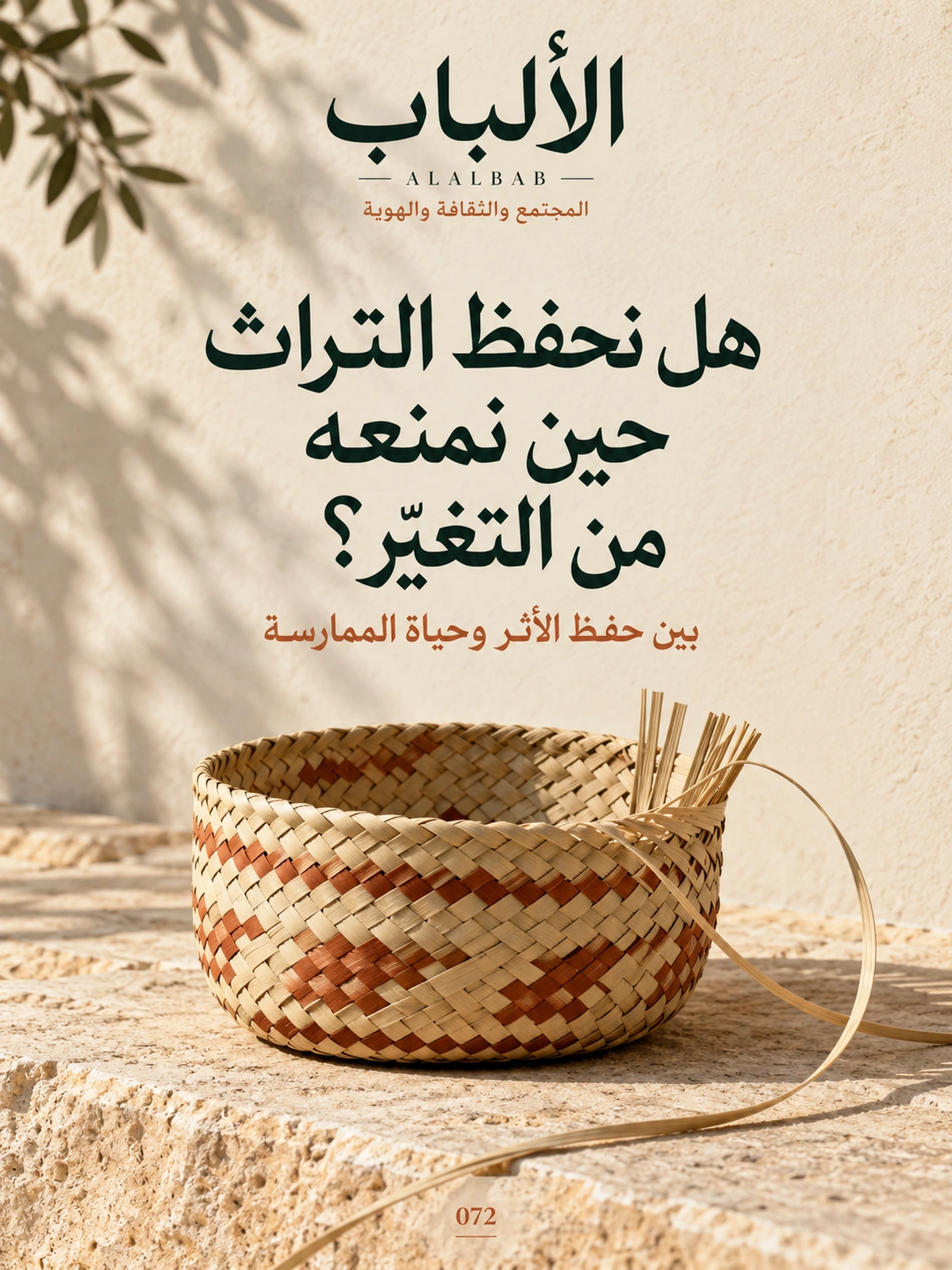
In an imagined scene, a grandmother sits beside her granddaughter with a half-woven basket. She explains where to pass the strip, when to tighten it, and how to recognize a tilting edge. The granddaughter suggests a smaller basket for her desk, instead of carrying the things older household baskets held. A watching relative interjects, “If we change it, it will no longer be our heritage.” Both pairs of hands pause. The disagreement is about more than a strip of palm frond: it concerns faithfulness to those before us.
We do not know which size best preserves the craft in this imagined scene. We can, however, distinguish three things: an old basket worth retaining as testimony to its time, a skill a new hand is learning, and a relationship between generations forming through work. One rule may serve one while harming another. Preserving an original object does not necessarily follow the same method as keeping a craft alive.
This explanatory article examines heritage and safeguarding, rather than presenting field research on a particular community. It draws on specific primary documents, separating them from imagined examples and editorial proposals. It asks not how to modernize everything old, but how to distinguish change that severs continuity from change that enables it.
Before We Begin
- Do we preserve heritage by preserving its form or the ability to practice it?
- Who decides what may change: expert, practitioner, or audience?
- When does protecting authenticity safeguard people's memory, and when does it prevent their choices?
- How can we criticize inherited practices while respecting those who passed them to us?
1. An Object We Preserve and a Practice We Continue
First ask what “heritage” means in each situation. A manuscript in its author's hand differs from the art of calligraphy a student learns today. The first carries irreplaceable material evidence, not replaced by a more beautiful copy; the second cannot survive merely by locking the manuscript in a cabinet. The manuscript may need less handling while learning needs repeated hand movements. There is no contradiction: the protected things differ.
UNESCO's 2003 Convention defines intangible cultural heritage through practices, knowledge, and skills communities recognize as their heritage. It mentions transmission across generations and recreation in response to environment and history. This is a convention's normative definition, not an experiment proving every change beneficial. Yet it includes life and renewal, rather than making rigid identity the only definition of continuity. Article 2
“is constantly recreated by communities and groups”.
Suppose a family keeps an old grinding tool. They can preserve it and show children its use without grinding with it every morning. Preserving the skill requires practice beyond viewing the tool. Preserving history, transmitting skill, and continuing daily use are related but distinct goals. Defining the goal prevents declaring success merely because we took a beautiful photograph.
Problems arise when “we preserved it” leaves unanswered what actually remains. A name may survive without knowledge, an object without its expert, or a method with changed materials. Ranking these before understanding the purpose is unwise. A modern educational replica may aid training without replacing a rare historical original. A valuable original may be well preserved yet insufficient to revive a craft.
We need more precise statements: we preserved a material example, documented an account, taught a skill, or reopened a place to practice. This is no linguistic luxury; it makes unfinished work visible. Someone documenting a recipe can then ask who will cook it; someone supporting a celebration can ask what remains after it ends.
2. Authenticity Is a Relationship We Can Examine
“Authentic” may mean old, identical to childhood memory, or honestly and skillfully made. These meanings can make people argue while defending different things. One fears losing a technique, another the community's name on a product, another a familiar appearance. Before judging, uncover the actual disagreement.
The Nara Document on Authenticity, produced by a 1994 expert meeting, connects heritage assessment with cultural context and trustworthy information. It lists dimensions including form, material, use, techniques, and location. Its primary context is heritage conservation and authenticity; it does not grant general permission to alter any artifact. Here it helps resist reducing authenticity to one visual standard. Paragraphs 9–13
“within the cultural contexts to which they belong”.
In a hypothetical case, a maker wants to replace a scarce material. “Change is good” and “Change is betrayal” are both insufficient. Is the old material the source of historical value? Does the substitute change the working movements being transmitted? Is the difference explained to buyers? Does the new product claim to be an old artifact? Each question reveals something absent from the product's image.
Honest naming is essential: “a contemporary design inspired by a local craft,” “an educational replica,” or “traditional technique with modern materials.” Such descriptions need not diminish value; they give recipients what they need to understand. Trouble begins when we dress the new in a history it does not own or present one account as the only form ever known.
The reverse is possible: rejecting work familiar to practitioners because it differs from a marketing image fixed in our minds. Practitioners' explanations deserve listening, just as documents deserve comparison. Respecting expertise does not make every historical claim true, nor does requesting evidence justify contempt for oral memory. Testimony, photographs, tools, and records can be combined while ignorance remains openly acknowledged.
Imagine three similar objects: an old piece with known provenance, a modern copy a learner made by the same method, and an industrial product with the same decoration. Each may have legitimate use and value for different reasons. The first is historical evidence; the second records learning and skill; the third is a visual product inspired by a form. Misrepresentation occurs when all are sold under one description, the second rejected merely for being new, or the third said to transmit skill merely because it transmits a drawing.
Separate age, provenance, method, and meaning. Knowing an object's date does not establish its manufacture; knowing manufacture does not prove its associated story. Work may be beautiful without a circulating origin story being confirmed. This frees us from inventing antiquity or heroism to recognize value, allowing research to correct narratives without makers feeling their entire effort erased.
Sometimes the honest phrase is “the earliest form we could document,” not “it was always this way.” Acknowledging limits protects heritage from easy, closed stories. The unknown is not a flaw to conceal but room for research, perhaps inviting evidence unavailable to the first narrator.
3. Who Carries Heritage, and Who Decides for It?
Heritage is not an abstraction moving by itself. People make, explain, remember, and disagree about it. Safeguarding must consider their conditions of participation instead of treating “the community” as one voice. At a local gathering, elders may speak easily while newcomers or home-based practitioners remain silent.
Article 15 of the 2003 Convention calls for involving communities, groups, and individuals who create, maintain, and transmit heritage in managing it. It offers no ready solution to every internal conflict, but makes participation central rather than decorative after decisions. Article 15
“to involve them actively in its management”.
Imagine organizers scheduling craft teaching when practitioners cannot attend, then blaming their lack of enthusiasm. Intentions may be sincere, but a simple question was missed: what enables knowledgeable people to participate? Payment, preparation time, workspace, materials, and attribution are not always external details. Here they become part of knowledge's capacity to travel.
Filming practitioners is not the same as involving them. They may permit recording a lesson for particular students without wanting their lives or private spaces public. Projects can explain in advance what will be recorded, where shown, and who benefits. These are practical ethical suggestions, not uniform legal rules; rights and procedures require local understanding. Respecting consent and clear agreement nevertheless provides a starting point.
Do not impose “guardian of the past” on young people before asking what they wish to learn. They may connect with heritage without devoting all their time to an image others expect. Older expertise can explain its depth and demands without humiliating learners for questions or mistakes. Relationships allowing questions offer clearer opportunities for transmission than those accepting admiration alone.
This does not mean every new preference must govern the project. Practitioners may have precise reasons to reject seemingly small changes. Both parties need room to explain, distinguishing technical requirements from changeable organizational habits. Understanding a rule's reason lets us preserve or revise it consciously; authority alone may preserve the command while losing its meaning.
4. The Distance Between Documentation and Learning
Recording an expert hand at work is valuable, but differs from acquiring the ability. Learners may see a movement without knowing why it pauses, or observe water quantities without understanding how material changes them. This difference can be tested in a particular skill; it is no claim that all traditional knowledge resists writing or filming.
Useful documentation can pair images with practitioners' working questions: how do you know a piece is ready? What error escapes beginners? When is this method unsuitable? Such questions move from displaying a product to understanding its decisions. Explanation may reveal legitimate differences between schools or families instead of erasing them to standardize teaching.
A UNESCO article published in October 2024 describes support for bandoneon teaching in Argentina and Uruguay: inventories of players and instrument makers, a school offering free youth lessons, and updated teaching methods. We cite the institution's account of the intervention, not an independent impact evaluation or proof that every similar school succeeds. Source
“young people can appropriate heritage, take pride in it, and renew it”.
Our proposed implication is limited: updated teaching may support an old practice's continuity. New lessons need not resemble the teacher's childhood lessons. Training can be staged, illustrated explanation added, or beginner tools provided while retaining what requires direct instruction. The suggested criterion is what learners can understand and do afterward, not how old the setting looks.
In a hypothetical basket-weaving project, a learner explains and attempts one step before the teacher, then describes the difficulty. This does not make a fully trained craftsperson, but identifies progress more specifically than opening-day attendance. With permission, projects can retain learning samples to identify stages needing more time or different explanation.
Describing activity differs from evaluating effect. A reported workshop tells us an activity occurred, not automatically how much participants learned or retained. Conversely, lack of long-term measurement does not render it worthless. State what is known, then ask the next questions: did learners return to practice, complete something new, or find help when stuck?
Small projects can follow these questions through clear notes and participant consent without falsely precise numbers. Stopping may reflect lack of time or materials, not rejection of heritage; returning may be social rather than skill advancement. A brief conversation may therefore explain experience better than assuming one meaning for attendance or absence. This is a proposed method of understanding, not an experimental finding.
Documentation itself needs description: when recorded, who speaks, which region or school is represented, and whether it describes current work or childhood recollection. A truthful, important account need not represent everyone. These details protect future readers from misusing recordings. Defining testimony's limits does not lessen its value; it makes value easier to understand and compare.
5. When Memory Becomes a Display
Wanting to present heritage attractively is natural. Exhibitions, products, and celebrations can each open knowledge. But examine their relationship with the practice displayed. Public interest may expand without training time; a name may become famous while working conditions remain difficult. These possibilities require project-specific investigation, not condemnation of all festivals or markets.
Imagine shortening lengthy work into a ten-minute stage demonstration. This may suit an introduction if viewers are not misled into thinking they saw everything. A performance can identify itself as an entry point and offer fuller explanation or contact with practitioners. The danger lies not merely in simplification, but in making the simplified version the only available image and then asking actual practice to imitate it.
Another paradox is loving signs of age on objects while resisting their owners' contemporary lives. Requiring craftspeople to endure difficult conditions so our tourist experience seems “real” is unfair. We can respect inherited techniques while improving lighting, comfort, and safety. If a change threatens important value, explain the value and risk instead of glorifying hardship itself.
Markets require concrete questions: do buyers know who made the work? Does branding distinguish traditional from inspired? Do practitioners retain a say in presentation? Sales may support continuity or encourage shortcuts that dissipate knowledge; price and fame alone cannot decide which. We need production methods and relationships' conditions.
Displays can also preserve diverse accounts. Instead of “This is the craft's form,” explain that an exhibit represents one maker's style alongside other documented styles. Every exhibition need not become an encyclopedia, but an accurate phrase can prevent broad exclusion. Responsible abridgment chooses and declares an angle without claiming to encompass what it omits.
A Serious Objection: Does Renewal Open the Door to Erasure?
The objection is strong: some changes are irreversible, and techniques may disappear if replaced before anyone learns them. A stronger party may invoke development to take the name and profits while excluding practitioners. Calling change renewal is insufficient for approval. Proponents should explain what remains, what may be lost, and who may object.
The answer is not faster change but distinguishing levels. Preserve a documented older model, teach its method to willing learners, and honestly label experiments in new work. Unique material artifacts require specialist conservation expertise; a new-basket analogy cannot govern manuscripts or historic buildings. Plurality benefiting living practice may not justify destroying irreplaceable evidence.
Communities may choose a particular form for its deep meaning, provided this is choice rather than coercion or harm. The aim is not compulsory renewal, but rejecting stability or change as automatic answers. Sometimes insufficient knowledge makes postponing change responsible; sometimes postponing adaptation closes continuity's path. Evidence, dialogue, and the nature of the object decide.
6. In the Light of the Quran and Islamic Wisdom
Islamic discussion of heritage requires a foundational distinction: revelation is not synonymous with everything inherited, and social custom does not become a religious ruling merely through age. Discussing changing customs does not authorize uninformed detailed judgments on rites or religious practices. The following reflects ethically on specific texts; it is not a ruling on a particular tradition.
TRANSLATION OF THE MEANING · COMPLETE VERSE 49:13O people, We have created you from a male and a female and made you into nations and tribes so that you may recognize one another. Indeed, the most noble of you before Allah is the most righteous[1] among you. Indeed, Allah is All-Knowing, All-Aware.Translation notes: [1] Lit., "the one who has the most taqwā among you," i.e., consciousness, piety, and fear of Allah.Rowwad Translation Center · QuranEnc · v1.0.20
The verse affirms common human origin and distinction through God-consciousness rather than boasting of ancestry. Ibn Kathir explains acquaintance through recognizing lineages while denying human superiority through inherited status. This can inspire mutual understanding and respect without claiming a detailed museum-management policy. Pride in knowing our heritage does not justify contempt for another heritage or its people.
TRANSLATION OF THE MEANING · COMPLETE VERSE 2:170When it is said to them, “Follow what Allah has sent down,” they say, “Instead, we follow what we found our forefathers doing.” [Would they do so] even though their forefathers had no understanding, nor were they guided?Rowwad Translation Center · QuranEnc · v1.0.20
The verse concerns rejecting what God revealed by appealing to ancestral practice; Ibn Kathir places it in condemnation of following error. It does not condemn all learning from predecessors or justify insulting elders. The reflection is that chronological precedence alone does not make every statement true. We can thank someone for transmitting a custom and question its meaning and effects without equating respect with unquestioning acceptance.
TRANSLATION OF THE MEANING · COMPLETE VERSE 5:8O you who believe, stand firm for Allah by bearing true testimony, and do not let the hatred of a people lead you away from justice. Be just; that is closer to righteousness. And fear Allah, for Allah is All-Aware of what you do.Rowwad Translation Center · QuranEnc · v1.0.20
The verse prohibits allowing hatred of a people to produce injustice. Applied reflectively here, dislike of a custom does not justify misrepresenting its practitioners, nor love of a community denying harm that needs repair. This is the writer's application, retaining the text's context. Love and criticism can coexist through accurate descriptions of actions and preservation of human dignity.
Wise dialogue asks elders for the reasons they learned and gives younger people space to explain their lives. Agreement may not follow, but accusations of betrayal or backwardness may become understandable questions. Not every generational gap is an identity battle; circumstances, tools, or needs may differ, and each possibility deserves hearing before judgment.
From an Idea to a Small Practice
Choose one familiar practice rather than attempting to “save heritage” in an expansive project: a making method, local account, or a plant's name within its use. Specify what to preserve, who knows it, and who wants to learn. Avoid purposeless collecting, and do not turn your wish to document into automatic permission to film people.
Begin by listening. Ask what the knowledgeable person considers important and what should remain unpublished. Agree on limited work: record a step, document a model, or hold a lesson. Note the date and speaker's name in their approved form, distinguishing their words from your comments. If witnesses differ, describe and preserve the difference instead of choosing the most attractive headline.
Then attempt actual transmission. Invite a willing learner to explain understanding or try a safe, appropriate part under the practitioner's supervision. Review what disappeared between explanation and attempt. Slow the lesson, reveal a step experts considered obvious, or add unclear vocabulary. These are revisable teaching suggestions, not a guaranteed scientific protocol.
If someone proposes change, compare clearly: what problem does it solve, what value might it affect, can it be tested without harming the original, and what will the result be called? Set a review time. The plan's worth is not its paperwork but making decisions and reasons understandable to successors, even if they choose differently.
Conclusion: The Thread Remains in Another Hand
Return to the imagined basket. The family may preserve the grandmother's basket, let the granddaughter make one for her needs, and jointly record what changed and why. This does not establish suitability for every craft, but illustrates preserving evidence while permitting practice without falsifying history or imprisoning the present within it.
We preserve heritage neither merely by preventing change nor merely by changing it. We try to understand what we carry, document knowledge, respect practitioners, and make room to learn and criticize. Deeper fidelity may mean passing the thread to another hand that knows its origin and understands enough to continue responsibly: neither mere repetition nor mere rupture.
Questions to Keep with You
- What do you want to preserve in a loved practice: form, skill, relationship, or more?
- Whose voice remains unheard when you speak for your family's or community's heritage?
- What change can you honestly try without destroying old evidence or erasing an earlier method?
- How will you know your knowledge reached another person rather than remaining a stored image?