

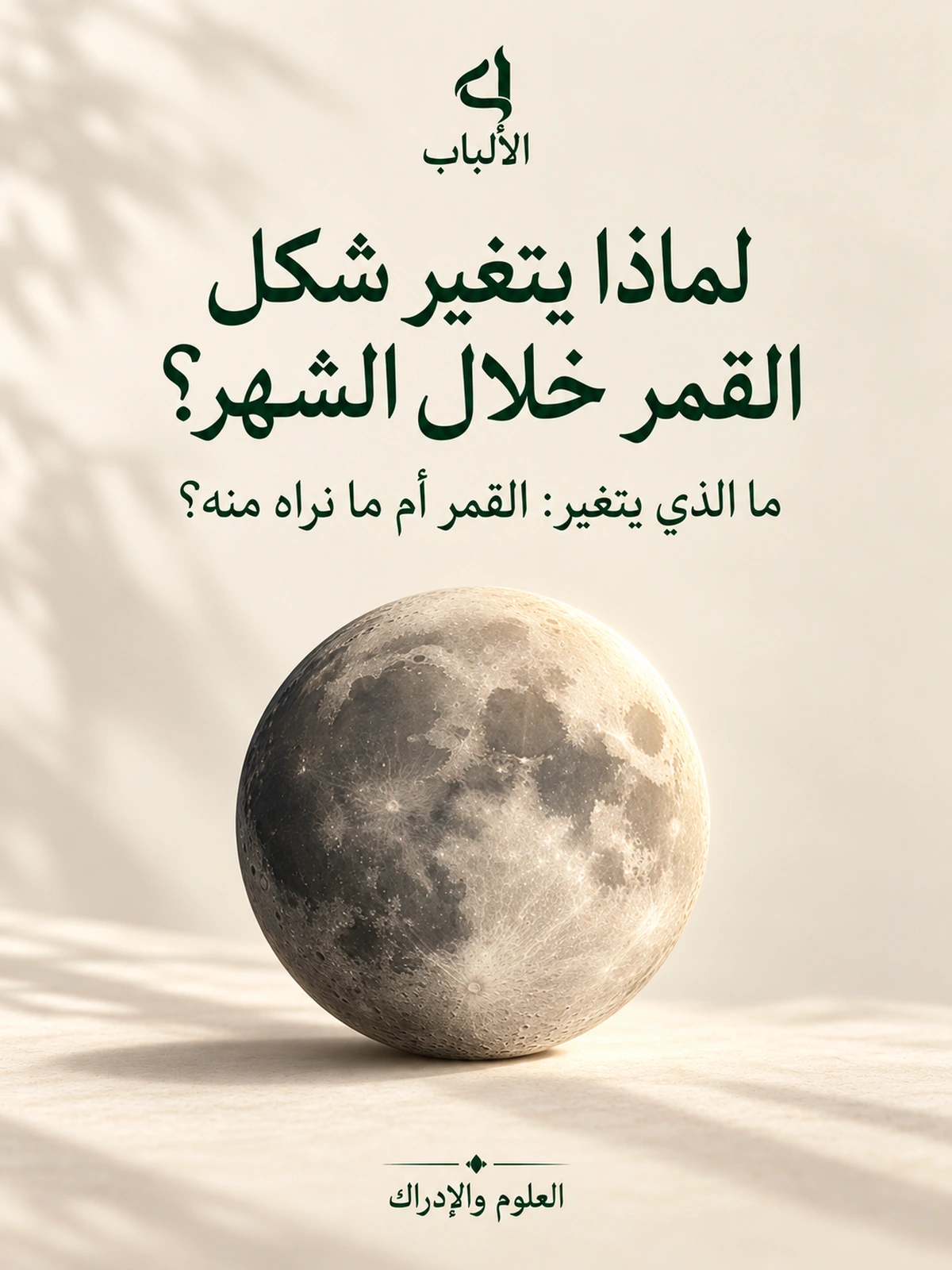
The Moon that seems incomplete
A child points to a slender crescent: where did the rest of the Moon go? We may answer that it will grow over the coming days and move on, satisfied with our explanation. But “grow” describes appearances and may suggest the body itself expands and shrinks. The small question deserves a pause: what actually changed, and what changed in our view?
The crescent is not a piece detached from a sphere, and the full Moon is not a body whose construction finished that night. Understanding requires three participants: a light source, a reflecting body and a viewing position. Forgetting one may turn the image reaching us into a direct description of the body’s shape, though that image reflects relationships among all three.
This article concerns lunar phases, not predicting visibility of a particular crescent. Beginning with the familiar sight, we distinguish illumination from appearance, phase from eclipse and two different meanings of a month’s duration. Then we return to the human question: how can we describe what we see accurately without losing the simplicity of wonder?
Opening questions
- Does the Moon’s body change when it appears as a crescent and then full?
- Why is every dark area not caused by Earth’s shadow?
- How can half the visible lunar disc be illuminated in a phase called a “quarter”?
- Does knowing new Moon timing tell us when a crescent can be seen everywhere?
1. A whole body and an illuminated part viewed from a particular position
NASA states: “The Moon does not make its own light.” This concerns familiar visible moonlight, reflected from the Sun. Ordinarily, outside an eclipse, sunlight illuminates about half the lunar sphere, while how much of that half we see changes as the Moon orbits Earth. Source
Approximate this with a pale ball in a dim room and a fixed household lamp relatively far away. One side receives light directly; the other remains less illuminated. Viewed from the lamp’s side, more illumination is visible than from the opposite side. The ball has not changed shape; the viewing position relative to its illuminated area has changed. This is a limited teaching model, not an accurate miniature astronomical system.
Most importantly, separate two questions: how much of the surface receives direct illumination, and how much of that area is visible from our position? The first may have an approximately stable answer while the second varies greatly. Combining them as “How much of the Moon is illuminated?” can make a correct answer seem to address something else.
At crescent phase we see a slice of the Moon’s daytime side; at full Moon we face most of it. Appearance changes gradually between them. The European Southern Observatory describes phases as resulting from our changing view of the illuminated surface. No weekly weakening and strengthening of sunlight is needed; geometry explains the basic change. Source
Why can a flat drawing confuse us?
Draw a circle and colour half dark. This quick symbol does not alone tell readers whether darkness represents night on a sphere, an obscuring object or different surface material. A drawing needs a key explaining colours and boundaries; it does not fully explain itself. Error may begin in reading a teaching symbol literally rather than in the information itself.
Before explaining the lamp-and-ball exercise, ask learners to draw what they see, then what they imagine happening. The first records appearance; the second reveals interpretation. A barrier drawn before the ball identifies the question to discuss. Merely correcting the phase’s name may leave the underlying idea unchanged despite a correct classroom answer.
The eye was not wrong to see a crescent. It supplied a real appearance from a specific position. The leap requiring review is from “I see an illuminated area this shape” to “The body itself became this shape.” Everyday language tolerates this when context is known; learning benefits from restoring what language compressed.
Imagine a photograph of a cup whose handle is invisible. The handle might be on the far side, or the cup might have none. The photograph alone settles neither. This editorial example concerns a view’s limits, not new astronomical evidence. It clarifies our question: are we describing the object or what the viewing direction made available?
2. Phases are not Earth’s shadow
NASA’s eclipse page says: “Lunar eclipses occur at the full Moon phase.” With suitable alignment, Earth lies between Sun and Moon and casts its shadow upon the Moon. Crescents, quarters and gibbous phases are not successive little eclipses. The lunar orbit’s inclination to Earth’s orbital plane prevents an eclipse every month. Source
The distinction goes deeper than names. In ordinary phases we see lunar night and day in differing proportions. During an eclipse, Earth obstructs light that would otherwise reach the Moon. One concerns our view of an illuminated area; the other concerns blocking illumination. Similar dark areas in two images do not establish similar causes.
Return to the lamp model. Place the ball so its illuminated side is visible, then insert another object between lamp and ball. Blocking is an independent change to the viewing arrangement. Do not mix both situations while explaining phases without naming the change. If your head casts a shadow on the ball, the model produces a different situation from the intended one.
A serious objection: is “part of the Moon is in shadow” not correct?
It can be acceptable when meaning the side not receiving direct sunlight. It misleads when listeners imagine Earth casting that shadow nightly. The issue is the causal picture left by the sentence, not one isolated word. More precise wording is: this is part of night on the Moon, not Earth’s shadow during an ordinary phase.
Good correction need not ridicule someone imagining Earth’s shadow. The idea seems plausible: familiar objects block light; a dark shape appears; we seek an object producing it. Learn from the error by asking what conditions should hold if the explanation is correct, then compare them with phases and eclipses. Questions then lead to understanding rather than testing status.
Try a simple language exercise. Beneath two imagined images, write “The visible illuminated part changed” and “Sunlight was blocked from reaching the Moon.” Before naming the phenomenon, explain each action. Who changes position? What blocks light? Where is the observer? Following these relationships reduces reliance on shape alone to identify the event.
The distinction also helps with headlines. A dramatic dark Moon may decorate news unrelated to an eclipse. The image need not be fraudulent; it may be illustrative. But decoration should not replace explanation. Read description, time and context, separating attention-grabbing material from evidence of the event.
This lesson has clear limits. Understanding the general distinction cannot identify an eclipse type from an undated image or predict a local astronomical event. Basic understanding helps form an appropriate question without supplying uncollected details. Acknowledging this is part of using knowledge, not retreating from it.
3. Why are there two different durations for a month?
NASA gives about 27.3 days for the Moon’s orbit relative to the stars, but about 29.5 days from one new Moon to the next. Earth also moves around the Sun during the lunar orbit, so the Moon needs extra time to restore a similar illumination arrangement. These approximate figures describe cycles with different reference points and do not contradict one another. Source
Consider reference frames through a nonastronomical example: a person circles a table while a marker outside it also moves. Returning to the same direction relative to a fixed wall need not restore the same relationship with the moving marker. This models no celestial speeds or scales; it shows how “completed a circuit” changes when its reference changes.
“Month” is so familiar we may think it needs no definition, yet familiarity does not remove multiple technical meanings. Confronted with differing numbers, first ask where measurement begins and ends and against what reference. A disagreement may disappear before assigning error because the numbers answer different questions.
The US Naval Observatory describes the phases: “Although this cycle is a continuous process”, before presenting the familiar eight phases. Their names mark points within continuous change, not states between which the Moon suddenly jumps. At quarter phase, roughly half the visible disc is illuminated; “quarter” does not mean only a quarter-disc appears. Source
Follow the full sequence to keep names connected with appearances: new Moon, waxing crescent, first quarter, waxing gibbous, full Moon, waning gibbous, last quarter and waning crescent. Waxing and waning describe increasing or decreasing visible illumination, not body size. Gibbous means more than half the disc illuminated but less than full. This verbal map organises observations without making every night equally easy to observe or replacing an image’s date. If phases appear in one row, explain that this is a temporal sequence of views, not actual sky positions or a scale drawing of celestial distances. Moon phases
A name does not replace identifying the quantity
Hearing “half,” ask half of what: the visible disc or the sphere’s surface? Hearing “quarter,” ask whether it names a cycle stage or an area. A fraction without its whole can make people agree verbally while imagining different things. Specifying the quantity restores a checkable meaning.
A teacher could ask learners to describe an image without phase names first: “I see an illuminated area smaller than half the disc, increasing according to earlier observations.” Then “waxing crescent” summarises that description. Naming follows understanding of properties rather than replacing it. This is an editorial teaching suggestion, not a claim from a published educational experiment.
Seeing an apparently full Moon also does not alone give the exact astronomical instant of fullness. The US Naval Observatory explains that the disc can look full on adjacent nights because the illuminated proportion changes relatively slowly nearby. Do not infer an exact hour from visual impression alone. Enough evidence to describe a beautiful view may not support precise timing.
Observation loses no value through this. Each tool and question has an appropriate precision. A simple observation can tell a child the Moon is nearly full. Comparing two astronomical-table times requires a definition of time, time zone and calculation source. Error transfers confidence appropriate to the first task into the second without adding needed information.
This explains the usefulness of “about,” “on average” and “appears.” They define the statement’s kind rather than merely soften responsibility. Yet needless overuse can obscure meaning. Precise wording selects qualifications that actually change understanding: an average duration, approximate appearance or description tied to an observer’s location.
4. The far side is not perpetual night
NASA states: “There is no permanent dark side of the Moon.” This rejects confusing the far side with perpetual night, without denying local permanently shadowed regions. The far side also receives sunlight. The Moon’s matching rotation and orbital periods keep approximately the same face towards Earth while illumination changes. Source
Distinguish “far from us” from “far from the Sun.” One defines a relationship with an Earth observer; the other suggests one with the light source. Substituting them changes the question unnoticed. “Dark” may attract storytellers through mystery, but literary meaning alone is no astronomical description.
Imagine a face drawn on a ball circling a centre while remaining directed towards it. Maintaining that facing requires the ball to rotate on its own axis too. Test with a small object on a table without treating it as a real-orbit measurement. Continually seeing a familiar side does not establish absence of rotation; specify motion relative to what.
NASA also explains that the lunar phase is generally the same for observers on Earth at the same time, while its orientation varies with location, including between hemispheres. A lone crescent image’s direction is no universal rule without knowing camera direction and location. Knowing phase differs from knowing image orientation.
What does understanding perspective give us?
We might use the Moon as a metaphor for human differences: each sees a side. It is beautiful when aware of its limits, but proves neither every interpretation right nor evidence incapable of settling disputes. Astronomy can describe viewing and illumination positions and compare results with a shared model. Different views invite added positional information, not abandonment of examination.
Everyday dialogue can borrow the question without claiming astronomy determines ethics. When accounts differ, ask what each person could see, at what time and in which context, and what remained unseen. This may resolve some disagreement or reveal one account incorrect. Do not preselect the conclusion; use the question to discover the situation.
Resist another metaphor: the crescent is no “less valuable” Moon waiting to become full. That is a human judgment added to shapes. Educationally, it is not a failed stage in constructing a body, but a view of an existing body in changing relationships. We can appreciate the human resonance without converting it into a law about people’s experiences or a description of their pain.
Wonder here is quieter than surprise. We see what we have seen repeatedly but now know which part of the question concerns the object and which concerns us. Explanation does not make the sky less beautiful. Small details may capture attention more readily because their differences no longer pass as recurring decoration.
In the light of the Quran and Islamic wisdom
Allah says: TRANSLATION OF THE MEANING · COMPLETE VERSE 2:189They ask you about the phases of the moon. Say, “They are a means for people to determine time and pilgrimage.” It is not righteousness to enter the houses from the rear [in pilgrimage][1], but righteousness is to fear Allah. So enter the houses through their doors, and fear Allah so that you may succeed.Translation notes: [1] It was an Arab practice prior to Islam to enter their houses from the back after assuming ihrām for pilgrimage, considering it an act of obedience.Rowwad Translation Center · QuranEnc · v1.0.20, an excerpt from Al-Baqarah, verse 189. Al-Saadi explains how changing crescents relate to worship times and human needs. Among his words are “so that people may know the times of their acts of worship” — an English rendering of the commentary, not a law of celestial movement. Commentary
Our editorial reflection is that a sight counted among night’s beauties can mark human relationships with time. The sky is not merely distant scenery; it also invites attention to a rhythm in which questions and appointments return. This draws on the verse’s timekeeping context without making it a substitute for astronomy or phase calculations its comprehensive interpretation.
A separate issue remains outside this article: astronomical new Moon is not crescent sighting. We offer neither a religious ruling establishing a month nor an announcement of visibility in a particular country. Celestial arrangement and observing a crescent from a particular place are different questions, each requiring appropriate information and procedures. Crescent observation reference
Practical application: a notebook separating observation and explanation
Choose a few suitable opportunities to observe safely, recording date, time and general location. Make this neither a perfection test nor a burdensome daily duty. The aim is a revisitable series rather than one image or a memory of a “nearly full” Moon on an uncertain night.
Each time, sketch the approximate disc boundary and the area you see illuminated. Write what you actually observed beside it, with interpretation on a separate line. For example: “Less than half the disc appears illuminated,” followed by the phase you consider likely. Separating them lets you revise interpretation without changing the observational description.
If clouds conceal the Moon, record inability to observe rather than draw an expected shape. If you never looked that night, say so. Absence of observation differs from observing absence: a blank notebook does not establish that the Moon was below the horizon. You may consult an astronomical source, but distinguish its data from your own observation.
Read two images before judging
Imagine friends send crescent images with different orientations. Before declaring one fake, ask what might change the interpretation: where and when was each taken, and was it rotated afterwards? This organises inquiry without claiming every difference has an error-free explanation. Information may clarify the cause or leave the question open.
Imagine a third image showing only a small lunar part behind a building. The boundary made by the building is not the phase boundary. Ask which edge belongs to the observed body and which to the foreground. A beautiful composition can combine layers; explanation separates them without cancelling their combined beauty.
Explain the idea to someone else
Begin with one sentence: the Sun illuminates one side of the Moon, and the illuminated portion we see changes with its position. Ask the listener to explain the difference from an eclipse in their own words. Verbatim repetition does not establish complete clarity; a short applied question can reveal whether changed appearance is distinguished from blocked light.
Use a household lamp and ball if needed, without directing intense light into eyes or viewing the Sun directly. Keep the limited aim: illumination’s relationship with viewing position. Infer no astronomical scales from the room’s ball size or distance, and do not treat a successful visual model as representing every orbital detail.
End with three written lines: what did we observe? What does the model explain? What does it not represent? The third is proper use of the tool, not an apology for it. A model with known limits is more useful than one asked to explain everything, then abandoned because one detail is absent.
You can also write a short lunar-image caption and review words exceeding the evidence. Did you call it the beginning of a month after checking only its appearance? Attribute its shape to Earth’s shadow? Say the far side never sees the Sun? These are small, specific corrections; every post need not become a long lesson.
Conclusion: what we see of a thing is not the whole thing
The Moon does not change from a thin piece into a complete sphere and back again. Phases change our view of its illuminated portion. Separating this from eclipses, synchronous rotation and different month definitions makes our explanation to a child more accurate without making it less accessible.
Perhaps the question’s best gift is a new way of looking: begin with observation, ask about our position and light source, then try a revisable explanation. The crescent remains beautiful, while the gap imagined as missing substance becomes room to understand the relationship between the world and the image reaching us.
Closing questions
- How would you explain a crescent versus an eclipse without a ready-made image?
- When hearing a month’s duration, do you ask its reference point?
- What must you know before comparing the Moon’s orientation in two images?
- What sentence would you now change for a child asking where the rest of the Moon went?