

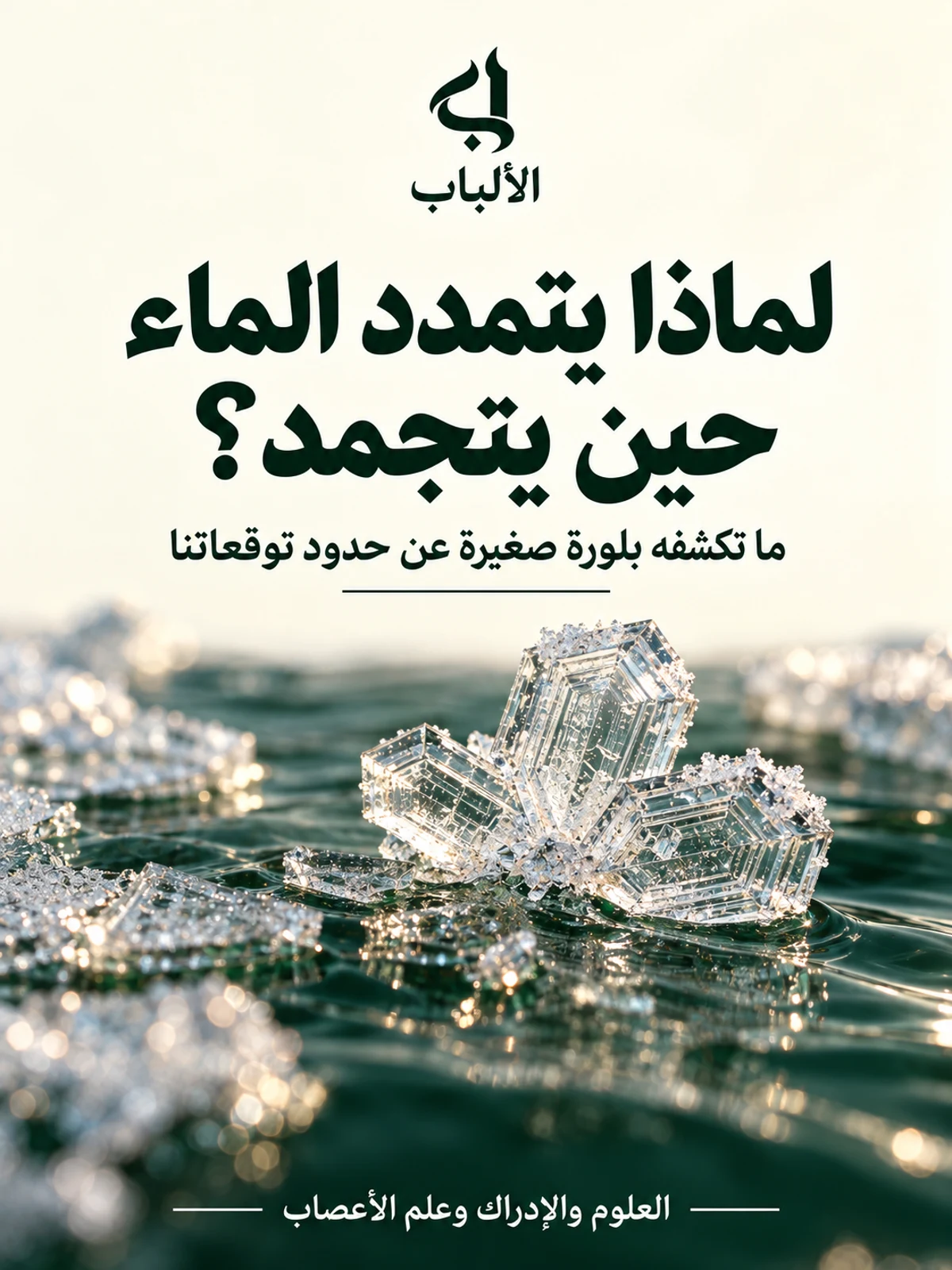
A cube larger than we expected
In an imagined scene, a father and daughter take an ice tray from the freezer. The child points at a slightly raised surface and asks: didn’t we fill the water to the same line? He says the water expanded, and she recalls a rule from an earlier lesson: things expand when heated and contract when cooled. Here something became colder but needed more space. Her observation is not wrong, nor is the entire lesson invalid. What is missing is knowledge of where the general rule applies and which conditions make water a case needing its own explanation.
Such questions open a different door from memorising a surprising fact. We could say “water is an exception” and end the conversation, but that classifies the phenomenon without revealing its mechanism. Why is it different? What changed between liquid water and ice? Did the molecules themselves grow? Does solidity always mean tighter packing? Everyday and scientific language meet here, revealing the need for more precise descriptions than words such as heavy, hard and full provide.
We will examine familiar ice and fresh water near ordinary atmospheric pressure, then explain why caution is needed when moving to seawater. We do not cover every form of ice under high pressure or prescribe how to protect pipes or test whether a frozen surface is safe to walk on. We seek an honest qualitative understanding that helps readers ask better questions while distinguishing a small model from engineering or environmental decisions requiring broader information.
Opening questions
- Why can volume increase as temperature falls?
- What distinguishes a sample’s volume from a molecule’s size?
- Does being solid necessarily mean being denser?
- When does an exception help improve a rule we know?
1. What actually grows?
The International Association for the Properties of Water and Steam, IAPWS, explains that liquid fresh water contracts as it cools to about four degrees Celsius, then begins expanding slightly before freezing, with its volume increasing by about nine percent on freezing under ordinary conditions. It connects this behaviour with molecular arrangement and bonding, stating: “This unusual behavior has its origin in the structure of the water molecule.” This original English quotation accompanies an editorial Arabic translation in the source article. Source
The first point is not the number but the question it answers. Comparing a quantity of water’s volume before and after freezing does not mean new water appeared. In a model losing or gaining no water, we are discussing the same material after a change of state. “How much material do we have?” must therefore be separated from “How much space does it occupy?” Casual speech may conflate them, but that creates confusion in explaining what happened.
Imagine a box containing the same number of toy pieces. Different arrangements can occupy different spaces. This example represents neither molecular forces nor proof of ice’s explanation; it only shows that unchanged components need not occupy an unchanged total volume. Once the analogy has served its purpose, we must leave it. Water molecules are not pieces we move by hand, and their arrangement is determined neither by conscious choice nor a wish to leave gaps.
Likewise, increased volume does not show that each molecule swelled like a balloon. We are primarily discussing molecules’ arrangement relative to one another. Distances between things differ from each thing’s size. Educational drawings may enlarge spheres and lengthen lines for visibility, so drawn dimensions should not be treated as a magnified photograph. A diagram proposes a relationship and needs explanation of what it represents and omits.
Without an analogy, we can say that the structure in which molecules settle as ordinary ice forms is more open than their average arrangement in nearby liquid water. The same quantity then has greater volume and lower density. “Open” does not mean visible holes in an ice cube, or room air entering to fill it. It describes structure on a scale different from visible cracks and bubbles.
It helps to pause over the approximate number’s use. Nine percent does not mean any household glass will show a nine-percent rise on a ruler. The container and surface shapes, possible water loss and reading method all matter. A reference figure reaches an application through measurement conditions, not merely by being written beside a picture. A home result can agree qualitatively without precisely confirming the percentage.
Separating an idea from its measurement prevents two opposite mistakes: rejecting science because a home attempt yielded a different number, or endorsing the attempt because we already know what it should show. Both require reading what actually happened. Measurement may be limited, a step uncontrolled, or the question broader than available tools permit. Acknowledging this is part of learning, not an apology for it.
2. Bonds not visible at first glance
OpenStax’s Biology 2e explains water’s molecular polarity: charge is unevenly distributed although the molecule has no net charge. Hydrogen bonds form between molecules, continually forming and breaking in the liquid. Freezing creates a more open crystal arrangement, making ordinary ice less dense than liquid water. The figure’s explanation summarises the connection: “Hydrogen bonding makes ice less dense than liquid water.” The source article supplies this original English alongside its editorial Arabic translation. Source
We must distinguish a bond within a molecule from attraction between different molecules. Saying water froze does not mean it split into hydrogen and oxygen gases. If every move between solid and liquid changed chemical identity, an ice cube melting in a glass would not suffice to explain its return to water. We need not know every chemical detail to preserve this basic distinction between a molecule’s composition and a group of molecules’ organisation.
“Bond” sometimes suggests a rigid rope that neither moves nor changes. We should therefore read the term within its model. A textbook may draw lines to illustrate an arrangement, but a line is not additional material stretching between two spheres. The term describes an interaction; the drawing helps us picture it. Forgetting that function moves us from using a model to treating it as the thing itself.
There is something surprising about a body becoming more ordered and less dense at once. We sometimes associate order with cramming things together until no room remains. But order describes a relationship between positions; it does not by itself require the smallest possible spacing. Evenly spaced chairs are more organised than a heap while potentially occupying more space. Again, the analogy clarifies a linguistic distinction rather than replacing the explanation of bonds.
A reader may ask: if ice is solid, why are its molecules not more crowded? The question reveals that solidity and density are different properties. Knowing one does not tell us everything about the other. We can use this moment to revise our description rather than simply memorise another exception. We seek not a new word replacing an old one, but a distinction giving each a specific job.
This becomes more useful when explaining to a child. “Because ice is lighter” may suggest half the material disappeared. “Because it contains air” may connect the phenomenon with visible bubbles. Instead we can ask: are we comparing equal-sized pieces, or the same quantity before its state changed? This opens a path towards density and prevents a quick answer creating a mistaken next question.
Precise terms do not oblige us to flood the conversation with them. Good explanation can introduce the relationship first, then name it. A reader saying the same quantity occupies more space has approached the idea before using “density.” Repeating “hydrogen bond” without knowing what the term connects may create a feeling of having answered while leaving the puzzle intact. A name helps complete understanding; it does not replace it.
3. From fresh water to the sea
NOAA places an important limit on generalisation: “Ocean water freezes at a lower temperature than freshwater.” This original English is supplied with an editorial Arabic translation. It explains that salinity makes ordinary seawater freeze near minus two degrees Celsius rather than fresh water’s approximate zero, and that its density changes differently during cooling. Source
We need not know every ocean detail to learn a methodological lesson from the difference. We began with fresh water, then added a dissolved substance. That changed description is not incidental. Changed conditions may alter what can be carried over from the first example. “Water” cannot guarantee identical properties regardless of composition, pressure and temperature.
Conversely, exceptions should not leave us unable to speak. We can offer a useful rule if its scope is clear. A specific statement is not weak merely because it does not include every case. It may be stronger than a broad one because readers know when to use it and when another reference is needed. Scientific confidence lies in explaining conditions’ relationship to results, not deleting them.
This skill is useful beyond water, but we offer it here as editorial reflection. A procedure may work in a small team and falter as participation grows; an educational method may suit one task but not another. Ice proves no law about organisations. It reminds us of a question transferable with caution: which condition changed? Judging the new case requires its own evidence, not a metaphor borrowed from a glass of water.
Nor should “natural” mean “always the same.” A natural phenomenon may change with conditions while that change remains regular and studyable. Water failing to match an initial expectation does not rebel against natural laws. We chose an expectation lacking a full description of the case. Moving from calling a phenomenon strange to examining our expectation turns wonder into a researchable question.
The National Snow and Ice Data Center describes freezing in the ground and notes that growing ice may involve drawing in and freezing additional water, not only expansion of the original quantity. It states: “When water turns into ice in the soil, it causes the soil to swell.” This original English accompanies the source article’s editorial Arabic translation. Source
This example shows the limits of a single explanation. Knowing water expands is insufficient to calculate movement in a damaged road, because the system is broader than a drop in a tray. Asking for more information does not deny the principle; it identifies where other principles and conditions must join it. Distinguishing a contributing cause from a complete explanation is fundamental to responsible use of knowledge.
4. The exception that rearranges the rule
When expectation conflicts with observation, we can defend or improve it. Defence may deny the observation, invent an unknown cause, or settle for calling the case strange. Improvement starts by separating the question’s parts: what did we observe, measure and expect, and which premise produced that expectation? These are editorial questions proposed to organise thinking, not a standardised psychological test.
The child need not apologise for remembering contraction. She used prior knowledge to ask a new question. Her father can say the rule describes many cases but needs conditions and detail. Correction then does not declare previous teaching worthless; it builds knowledge better able to discriminate. Sometimes we learn by adding information, and sometimes by redefining the boundaries of existing information.
Yet celebrating exceptions too much can obscure their real usefulness. Water’s unusual behaviour does not mean every rule can be disregarded or every contrary opinion deserves belief. A scientific exception itself needs observation, explanation and definition. A claim is not strong because it surprises, or weak because it is familiar. Its strength comes from evidence and precision about what it asserts.
A serious objection: is this a long explanation of a simple fact?
A brief answer may suffice in some settings: ordinary ice is less dense because of its molecular arrangement. To understand the relationship, however, further questions are legitimate: what does arrangement mean, what stayed constant, and why not generalise to all water in every circumstance? Length guarantees no depth and may become repetition. Its value lies in resolving a particular confusion and enabling readers to use an idea without unjustified expansion.
Another objection asks whether we borrow human lessons from nature unrelated to science. Yes, that is a risk when metaphor is presented as proof. We therefore separate molecular explanation from reflection on learning. Water does not prove empty space useful in every relationship, distance beneficial for every team, or hardness evidence of psychological strength or weakness. Those judgements require entirely different research.
What we can retain is care in questioning: not rushing from a familiar name to a sweeping conclusion. This is a choice in reading and teaching, not a property found inside a crystal. Stating it clearly gives reflection its proper place instead of false authority. Scientific writing may evoke human meaning, but must show where evidence ends and the writer’s proposal begins.
Some uncertainty may remain afterwards. Readers may understand structure’s effect without being able to calculate or represent it precisely. That is not necessarily failure. Qualitative understanding explaining a result’s direction differs from a quantitative model producing a measurable value. We should neither claim the second when possessing the first nor despise the first for not being complete expertise. Identifying our level of understanding helps choose the next step.
In the light of the Quran and Islamic wisdom
Allah says: TRANSLATION OF THE MEANING · COMPLETE VERSE 21:30Are the disbelievers not aware that the heavens and earth were joined together and then We split them apart? We created from water every living thing. Will they not then believe?Rowwad Translation Center · QuranEnc · v1.0.20, an excerpt from Surat Al-Anbiya, verse 30. The verse calls for reflection and faith. Al-Saadi explains matters relating to rain, plants and reviving the earth, saying within his commentary, in an English rendering: “The sky with rain, and the earth with plants.” Al-Saadi’s commentary
We do not present the excerpt as an explanation of hydrogen bonding or an equation for ice expansion. The Quranic text and commentary have their context, and investigation of physical properties has its tools. Our proposed connection is reflective: what we habitually use may deserve a look beyond habit. We can learn about water and recall its value to life without making every modern detail a necessary interpretation of the verse.
Gratitude here does not require understanding every property before appreciating a blessing. Appreciation also does not replace learning when knowledge is needed for responsible action. Someone working in a water-dependent field needs appropriate expertise; a general reader needs awareness of what they have received and its limits. Religious reflection does not remove responsibility for verification, and science does not reduce things’ value to numbers alone.
The father can speak with his daughter about water’s blessing without stopping her questions. Perhaps his finest contribution is not confusing what he knows with what needs a source. This is not a recommendation we attribute verbatim to Al-Saadi, but an editorial educational proposal. We preserve attribution of commentary and keep our proposal visibly human, open to discussion and revision.
If an ice crystal inspires admiration, we need not turn that into a grand claim. Greater attention to the familiar may suffice, with understanding that seeing something clearly does not mean knowing it completely. Quiet reflection needs no conflict between scientific questioning and faith’s meaning. It needs honesty allowing each discourse to say what it can support and leave the rest without haste.
Practical applications: a small notebook for a specific question
Write your expectation before observing. What do you expect to change when water freezes? Specify volume, mass and state separately. The aim is not a correct answer in advance, but preserving the distinction between expectation and learning. After reading, revisit the first sentence and identify what became clearer. The real change may concern a word’s meaning rather than memorising a new number.
You can simply observe a ready-made ice cube in water in a safe container. There is no need to freeze a sealed bottle or a full glass container to demonstrate expansion. Do not use trapped pressure, break a container, or infer that a natural frozen surface is safe to walk on. Home observation is for learning; activities with children should suit their ages and have adult supervision.
During observation, ask one question: what do I see directly? Perhaps part of the cube above the water. You do not see molecular structure with your eyes in this activity. Knowledge of it comes from specialist sources, models and evidence. Separating these levels prevents claiming to have observed bonds, and prevents thinking that what is not directly visible in a glass cannot be known by other means.
Next, sketch the same components in two approximate arrangements. Label the drawings as illustrations of an idea, not molecular measurements. Make their purpose clear before trying to make them beautiful. A simple drawing acknowledging its limits may help more than a splendid image implying complete revelation. The aim is to learn to use representation, not give it the status of evidence by itself.
Choose a statement and identify its source. For salinity, consult NOAA; for bonds, begin with OpenStax; for thermal behaviour, read IAPWS. Five links at the end are insufficient: you should know which supports which claim. References then become paths readers can follow and use to review the writer, rather than decoration.
Look next for the boundary the page does not answer. It may explain a source of expansion without designing a particular container, or explain ocean freezing without guaranteeing ice’s suitability for drinking or travel. Do not fault a source for omitting a question outside its purpose. Know when another reference is needed instead of stretching a true statement to carry what it never said.
You can exchange explanations with someone else, aiming at understanding rather than embarrassment. Ask them to describe what they understood about quantity and volume, then listen for confusion. If they repeat something unintended, your explanation may need improvement; do not immediately decide they were inattentive. Rephrasing sometimes reveals that our words allow a reading we missed while writing.
Keep one unanswered question on a separate line. It may concern pressure changes or another form of ice. Do not fill it with a comfortable guess to make the notebook seem complete. A precise question is more researchable than a vague answer. At the same time, one remaining question should not cancel what you already understood. Honest partial knowledge can support further learning.
A useful exercise compares “Ice floats because it is cold” with “Ordinary ice is less dense than liquid water under the conditions we are discussing.” Which identifies a discussable relationship, and which merely names an accompanying feature? You need not know every possible experiment’s answer to notice the difference. This directs attention to explanatory sentences: did they identify the relationship, specify its scope and leave a path to verification? Repeat it with statements from books or conversations while respecting different subjects and not assuming one formula suits every question.
Closing: the crystal and the limits of expectation
The child returns to the tray, finding the raised ice less mysterious. Water did not multiply, and falling temperature never promised that every volume would shrink. Molecular arrangement changed in the case studied, giving the same quantity a different space. She learned more than an exception to add to her notebook: a more precise way to describe the question. Which water, state and conditions, and which property are we comparing?
The crystal can remain beautiful when we know some of its causes. Science can make wonder more specific rather than dispel it or turn it into a mysterious tale. Our proposed human lesson is simple and limited: when reality contradicts expectation, there may be an opportunity to improve that expectation. We need not discard all prior knowledge; sometimes we need to give it boundaries that make it truer and more useful.
Closing questions
- What distinguishes increased volume from increased quantity of material?
- Which statement explaining ice could mislead if its conditions were removed?
- How do you distinguish what you observed yourself from what a source taught you?
- What question remains after understanding the qualitative explanation?