

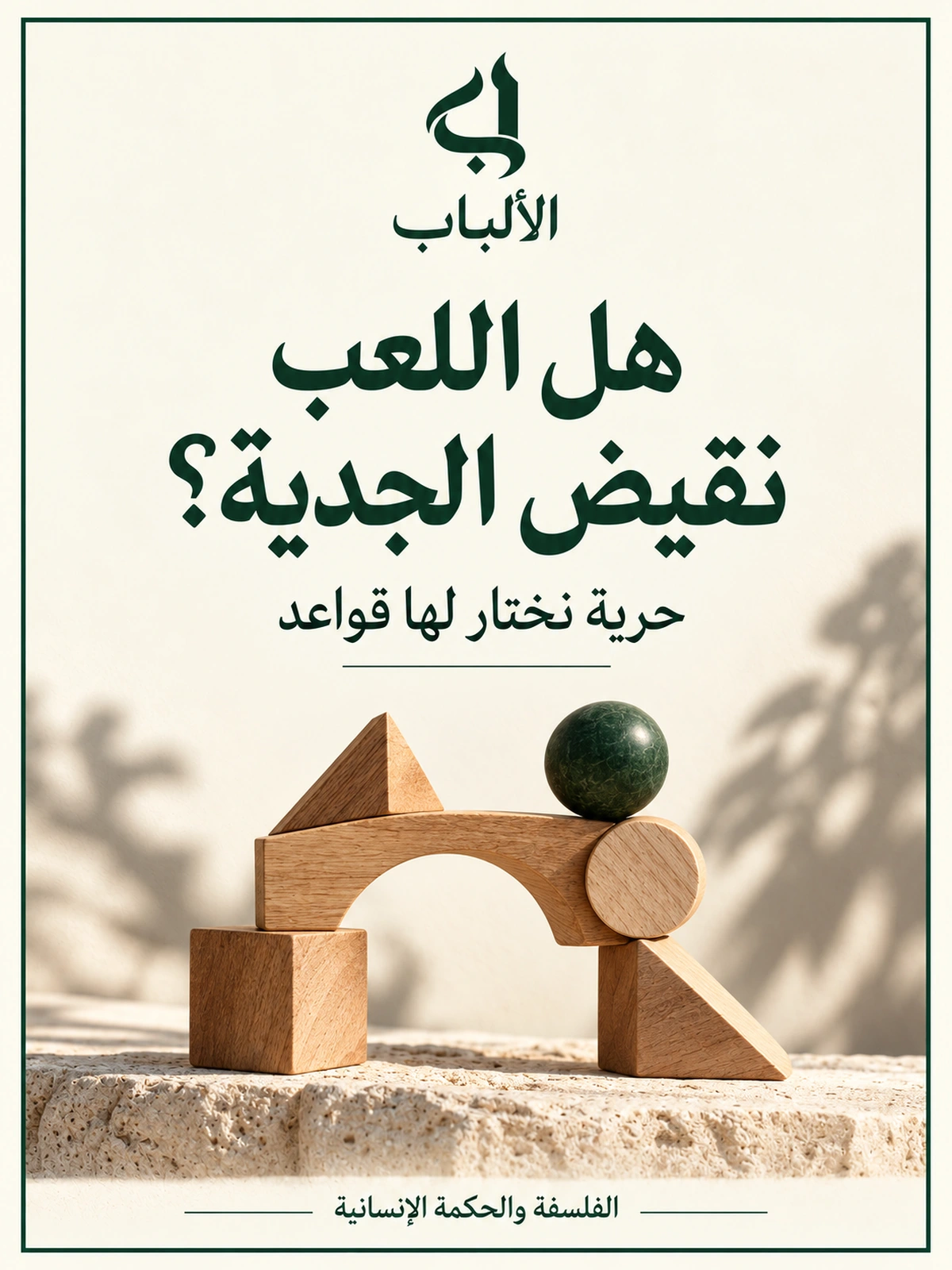
An evening with no result to report
The following scene is imagined: four friends sit around a table with wooden pieces of different shapes. One suggests building a bridge supported by only two pieces, with a small cup able to pass beneath it. There is no prize, no planned photograph to publish, and no professional skill for their résumés. Nevertheless, one bends down to check the balance, and another asks to start again because his hand touched the structure before it was complete. They laugh when it falls, then seriously disagree about the meaning of their agreed condition.
If someone entered and said “It is only a game,” they might mean to ease tension. They might also mean the activity does not deserve this attention. Our question begins here: is seriousness a quality only of things we profit from, or can it describe how we attend to something we chose? Does taking a game seriously spoil it, or does a game need some seriousness to exist at all?
This reflective article draws on philosophical and historical texts, offering neither a therapeutic programme nor a claim that all play improves health or creativity. Its subject is narrower: how should we understand freedom, rules, and responsibility when we play? Its everyday examples are suggestions for understanding, not scientific findings.
Questions to begin with
- Does seriousness mean every moment must produce a measurable result?
- How can a rule be both a chosen restriction and a condition of our freedom?
- When does play change from free participation into an imposed duty?
- How can amusement have its place without excusing neglect of rights?
1. Seriousness is not a facial expression
We may see a silent person and judge them serious, or a laughing person and assume they do not care. Yet a face alone does not reveal attention or sincerity. Someone laughing can listen to a partner’s suggestion and carefully try again; someone frowning can pretend to work while mentally absent. The seriousness explored here is not a visual announcement of self-importance, but willingness to give an activity the attention it requires.
The historian Johan Huizinga says that play:
“can be very serious indeed”.
This does not establish that every game is profound or beneficial. It helps prevent defining play solely through the absence of seriousness. The friends’ commitment to the bridge condition is no mistake needing correction; it makes their attempt shared and intelligible. If anyone can change the condition at will, success and failure lose their agreed meaning.
Yet not every observation about a rule deserves turning the evening into a courtroom. We can distinguish care that preserves an experience from care that takes it over. The first asks: how can we continue so everyone knows what they are doing? The second asks, perhaps silently: how do I prove that only I know the right way? The difference appears in willingness to explain, acceptance of mistakes, and how much room remains for others.
We need not choose between carelessness and rigidity. We can take the attempt seriously while remaining light about our image within it. The bridge’s collapse matters to the round’s goal, but is no verdict on the intelligence of whoever placed the last piece. Distance between an action’s outcome and its maker’s worth lets us try again without denying what happened.
2. Freedom choosing its form
In work we did not choose, rules may seem like commands from outside. In a game made together, we choose to prohibit some possible routes so a particular experience can arise. The friends could secure the bridge with glue, but that would end the question they wanted to test. Prohibition does not merely deny a solution; it creates the kind of solution sought.
Examples unrelated to winning clarify this. Friends writing a story together might add one sentence each; someone improvising a drawing might limit themselves to two colours. Constraints do not automatically make work free, but may give freedom a direction to which another can respond. The difference between choosing a constraint and submitting to it lies in the relationship, not simply the instructions’ form.
In the fifteenth of his letters on aesthetic education, Friedrich Schiller writes:
“he is only completely a man when he plays”.
This statement is no ready certificate endorsing every amusement. Schiller discusses the play drive in the context of beauty and reconciling the human sensuous and formal aspects, cautioning that he does not simply mean popular everyday games. It is a philosophical thesis about the completeness of human experience, not a psychological measurement or a recipe making us better merely through play.
A reflection available without accepting his entire philosophy is that human beings live neither by commands alone nor impulse alone. Sometimes we choose a form and freely inhabit it: a poem’s metre, a conversation’s rhythm, or a game’s condition. The experience succeeds not because boundaries disappear, but because we can understand, agree to, and revise them if they undermine its purpose.
Respect for rules should therefore not become a blind virtue. If a rule excludes someone without reason or gives them a humiliating role, they may object. Participants can agree to revise it before a new round. Fidelity to agreement does not make an old agreement sacred; changing it requires clarity and participation rather than a trick giving someone a hidden advantage.
3. When enjoyment becomes another demand
We may defend play by saying it makes us more productive. Perhaps it does in particular contexts, but the defence leaves an unsettling question: what if the evening produces nothing usable tomorrow? Is it then worthless? If experience is allowed only as training for later work, we may carry work’s language into the time we thought we had left it behind.
This rejects neither learning nor skill. Trouble arises when every participant must prove improvement or correct investment of time. A chosen activity may then become another examination. Part of a pleasant gathering is needing no final report: participating, treating each other well, and leaving with a memory not demanded in advance can be enough.
Discussing board games, Huizinga observes:
“they all contain an element of seriousness”.
In the same chapter he argues that increasing organisation and professionalisation of sport may weaken something of play’s spirit. This opinion should remain in historical context; it is no definitive empirical judgement on every professional today. A professional may find real pleasure in mastery, while an amateur may make a simple gathering harsh for everyone. Pay’s presence or absence alone cannot judge the experience.
The practical criterion proposed here concerns room for choice: can a participant say they are tired? Can they try a method that does not guarantee superiority? Do they remain accepted when not the best? Answers may differ by activity, but asking reveals what “entertainment” conceals when used to cover genuine pressure.
This becomes clearer when a manager calls an activity optional fun, while employees know absence will count against them. The problem is not group play itself, but the contradiction between description and authority. Compulsion does not become freedom through a pleasant name. Respecting someone unwilling to participate may preserve play’s spirit better than forcibly persuading them they must enjoy themselves.
4. A serious objection: does this justify escape?
Someone may object that discussing play’s value forgets people who postpone their duties daily. The objection is valid. Choosing an activity does not exempt it from effects on others. Someone who promises family a time, then disappears into an extended round, cannot resolve the problem by saying they need personal space. A specific promise and waiting people are involved, not merely disagreement over enjoyment’s value.
Addressing neglect, however, does not require condemning all time producing neither money nor achievement. Naming the effect is more precise: a broken appointment, wasted expenditure, interrupted necessary sleep, or someone left carrying a shared responsibility alone. Naming harm permits repair, while accusing all play may prompt defence of a right to rest instead of acknowledgement of the action needing change.
Another objection is that someone lacking safe time or accessible space may hear this as luxury. We should not make ability to play a standard of the good life by which exhausted people are judged. We can also ask about the distribution of time and responsibility within a home or team. Sometimes people need no advice on enjoying themselves, but someone to share the load that prevents them breathing.
Activities also differ in effects and rulings. This article gives no general permission for everything called a game, and does not make consent alone sufficient where exploitation or harm exists. It examines our relationship with an activity permissible and safe in principle, asking when we preserve its freedom and when its name conceals a problem requiring attention.
In the light of the Quran and Islamic wisdom
Allah says in Surat Al-Hadid:
TRANSLATION OF THE MEANING · COMPLETE VERSE 57:20Know that the life of this world is no more than play, amusement, adornment, boasting among yourselves, and competition in wealth and children. It is like plants that flourish after rain, pleasing the sowers, then they wither and you see them turning yellow, and then they crumble. And in the Hereafter there will be severe punishment, or forgiveness from Allah and His pleasure. For the life of this world is no more than a fleeting enjoyment.Rowwad Translation Center · QuranEnc · v1.0.20
Al-Saadi connects this description to heedlessness of remembrance of Allah and the Hereafter, and taking worldly life as the final aim, contrasting it with making life a passage for righteous work. The context cannot be reduced to a question about a particular game. The relevant reflection is that an activity’s scale and serious appearance do not guarantee a sound direction: someone may be absorbed in what they call achievement while missing a more important right or purpose.
In the report about Salman and Abu al-Darda in Sahih al-Bukhari, Salman says:
“Give everyone who has a right their due.”
This concerns the rights of the Lord, oneself, and family in the context of fasting and night prayer, rather than a hadith specifically about recreation techniques. For our reflection, it suggests that ordering life does not mean allowing one aspect to monopolise it. We invent no daily amount of play from the text and cancel no duty; we recall it while balancing rights.
On this basis, a lighthearted gathering can coexist with care for responsibility, while amusement can become neglect if it consumes an established right. These are editorial applications of the meaning, not rulings on every new form. Questions about the specific activity, context, and effects remain necessary.
Applications: a small agreement protecting the gathering
Before a shared activity, clarify the aim briefly: trying something new, organised competition, or simply time together? Different aims are no failing, but leaving them hidden makes everyone think others are spoiling what they came for. A shared purpose makes choosing rules and duration easier.
Agree on an ending that can be honoured and on how to treat someone who wants to leave. Not every stop rejects the group, and not every wish to continue confers a right to others’ time. Short rounds can renew consent rather than make initial participation an indefinite commitment.
When disagreement arises, first ask whether it concerns a known rule or a meaning left unclear. In the latter case, replaying after clarification may be fairer than each side insisting their understanding was obvious. Mocking someone who objects does not resolve uncertainty; it makes them pay for requesting clarity.
Afterwards, one limited question may help: did each of us have a place and a voice? No comprehensive evaluation or survey of every moment is needed. It may suffice to notice someone kept waiting for a turn, or that a short explanation would have let a newcomer join. Improvement preserves the relationship without turning recreation into another administrative project.
If the activity has become a regular means of postponing a commitment, begin by renewing agreement about that commitment. We need neither promise to eliminate everything we love nor ask the person affected to endure indefinitely. Specific repair is more honest than passing enthusiasm: a known time, shared responsibility, and a promise that can be kept.
Conclusion: playing without belittling
When the friends finish their bridge, they return the pieces to the box. No structure remains worth displaying, but that does not make the evening a fraud. They chose a small problem, gave it attention, and explored agreeing and disagreeing without turning disagreement into hostility. This is one possible reading of their imagined experience, not a promise that every game produces virtue.
Play may be serious in respecting participants and agreed rules, and light in not making its outcome a final definition of ourselves. Seriousness can exceed sternness, and freedom be more precise than doing whatever occurs to us. Between them is room to choose to care without claiming the whole world depends on our attempt’s success.
Questions to leave with
- What activity do I reject for producing nothing, despite finding meaning in it?
- Are the rules we ask people to respect clear, agreed, and open to review?
- Can another person refuse participation without social punishment?
- What specific right should I protect to keep playtime fair?