

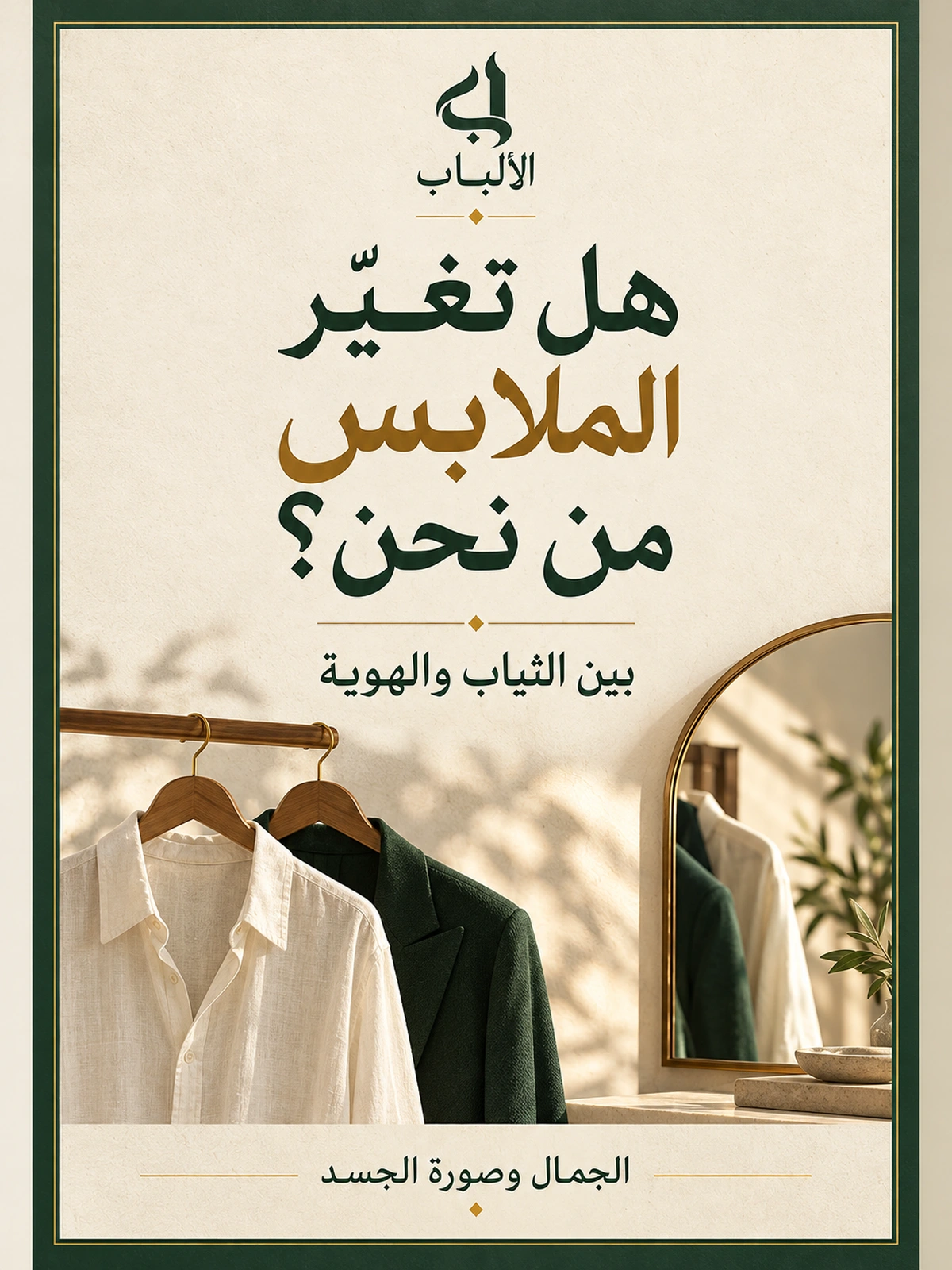
In Front of the Wardrobe
In this imagined scene, a man stands before his wardrobe on the morning of his first day at a new job. He tries a jacket, then puts it back. It is not that it fails to suit him; it suits the image he hopes others will see more than how he feels now. He chooses a simpler garment, then hesitates: does he look confident enough? His young son enters and asks whether he will become someone else at the office. He smiles, but carries the question with him to the car.
We need no exceptional occasion to know this hesitation. We may keep an item because it holds a memory, reject another because it puts us in an unwanted role, and choose clothing because a place requires it. Each time we seem to answer a practical question: what shall I wear? Behind it lie questions of belonging, respect, and freedom, and of the distance between a person and the image they present.
This is a reflective article, not an experiment proving that a particular garment increases intelligence or confidence, nor a guide to diagnosing people through their wardrobes. Its subject is ethical: how do we use the language of clothes without letting it reduce us? How do we read others’ appearance while acknowledging that what we cannot see in them is greater than what we can?
Questions to Begin the Reading
- What can clothes express, and what can they not prove?
- Does changing our clothing mean abandoning our identity?
- When does fitting the setting help us, and when does it become self-erasure?
- How can we respect beauty without ranking people’s dignity by the price of their clothes?
1. Clothing Offers a Signal, Not a Life Story
Some signals reach others before we do. A work badge or professional clothing may indicate a role, and an outfit chosen for an occasion may tell us that its wearer understood its nature. But a signal is not a life story. Seeing someone in formal clothes does not prove they are honest, just as a simple appearance does not reveal how much someone knows or can achieve.
Noticing clothes is not the problem; it is part of an encounter. The problem starts when we finish the story ourselves. We move from seeing a particular fabric to assuming taste, income, upbringing, and character, then forget that most of these details were never stated by the person. The choice may reflect habit, necessity, a temporary loan, or a decision unrelated to the meaning we attributed to it.
Even a familiar symbol needs context. People may wear professional clothing because they are at work, not because they want the role’s authority to extend into every conversation. They may wear traditional clothing to express a connection they love, without claiming to be that culture’s sole representative. Respecting a signal differs from turning it into open permission to interpret a life.
We can therefore train our language towards greater precision. Instead of saying someone is arrogant because of their clothing, we can say we saw striking clothes and do not know why they chose them. Instead of inferring seriousness from price, we look at working methods, punctuality, and clarity. This precision does not prevent opinions; it prevents an opinion from claiming complete knowledge.
2. Changing Roles Does Not Undo a Person’s Unity
People change clothes between home, work, exercise, and visits. This does not seem inherently hypocritical: places make different demands, and the body itself needs comfort, protection, and movement. Why, then, do we sometimes feel that a new item threatens our honesty with ourselves?
Perhaps we give some choices more meaning than they can bear. We say, “That is not my style,” sometimes meaning only that it was not familiar before. But familiarity does not equal the whole of identity. Taste can expand, and people can learn to suit a new occasion without erasing what they love. Continuity in values does not require freezing every visible detail.
Imagine a young man wearing formal clothes for the first time to present a project. He may feel strange because he is unaccustomed to them, not because he is performing a false personality. The better question is whether he can speak honestly, admit what he does not know, and treat those present respectfully. If so, the clothing may frame a genuine situation rather than mask and replace the person.
Conversely, we should not make adaptation a virtue without limits. If its price is shame about one’s origins or constant apologies for one’s body, the matter has gone beyond choosing fabric. We need to distinguish accommodating a particular occasion from conditions that offer acceptance only after someone disowns themselves. This article does not settle every social disagreement about dress, but it rejects humiliation as the price of belonging.
Our identity includes things a mirror cannot capture: promises we keep, how we apologise, and what we do when we could exploit someone but refrain. These are ethical examples, not an exhaustive personality checklist. They remind us that a person’s constancy may appear in actions across many outfits more than in holding to a single appearance.
3. Care Does Not Require a Claim to Superiority
“Allah is beautiful and loves beauty.” The Prophet Muhammad, peace and blessings be upon him, from Abd Allah ibn Mas‘ud’s report, Sahih Muslim 91a, excerpt. English rendering of the Arabic hadith. The hadith in context
This answer followed a question about liking fine clothes and shoes, in a hadith warning against arrogance. Its continuation gives a criterion concerning rejection of truth and contempt for people. We should neither extract permission for every action in beauty’s name nor make fine clothing an ethical accusation in itself. The direct connection here is the need to distinguish care for appearance from superiority towards others.
We can love harmonious colours, good craftsmanship, or the feel of comfortable fabric. These interests do not demand proof that we are better. Care may express respect for an occasion or simple pleasure. But the meaning changes when we need someone below us on an imaginary ladder in order to enjoy what we wear.
“Arrogance is rejecting the truth and looking down on people.” The Prophet Muhammad, peace and blessings be upon him, continuation of the same hadith, Sahih Muslim 91a, excerpt. English rendering of the Arabic hadith. Source
When a garment’s owner becomes preoccupied with those unable to afford its like, fabric becomes a tool for ranking people. This danger is not confined to expensive clothes: boasting of simplicity can become another way to despise others. The competition changes shape while the pursuit of superiority remains. We cannot know this is happening in a particular heart merely by looking; we use the question to examine ourselves.
There is a difference between saying, “This choice expresses something I love,” and saying, “I have no value unless people see its value.” The second puts our day in the hands of an audience we cannot control. People will not agree about our tastes, and every remark should not become a vote on our right to appear. We can learn from a useful observation without surrendering our whole definition to it.
4. Suitability Needs an Understandable Purpose
Some clothing protects against danger, some helps identify a person’s job, and some is requested according to an occasion’s traditions. Not every rule attacks freedom. But a rule becomes clearer and fairer when we know its purpose, limits, and what happens when compliance is impossible.
If worker safety is the purpose, discussion concerns suitable protection and requires specialists. If the purpose is a coordinated appearance when receiving guests, local taste should not be presented as a truth about an employee’s dignity. Distinguishing the purpose prevents confusion between necessity and custom, and between performing a task and passing judgement on a person.
In everyday encounters, we can accommodate a setting without spending beyond our means or pretending to be what we are not. This is a general ethical observation, not financial advice. Often the useful question is: what level achieves respect and comfort here? Not: what will make me the most noticeable person present? The answer may vary by occasion; no single garment can serve as a law for every life.
A Serious Objection: Do Appearances Not Really Matter?
A reader may say that talk of inner substance is appealing, but people respond to appearance, and ignoring this may cost an opportunity. The objection points to a reality worth understanding: criticising quick judgement does not require denying its existence. Yet acknowledging that appearances may affect people does not turn every social expectation into a standard deserving obedience.
We can improve our self-presentation while asking for standards more relevant to the work. An applicant can take account of the task’s context, and the person responsible can ask about competence instead of settling for an impression. The weaker party should not alone bear responsibility for repairing a workplace culture or be asked to fight every possible battle in their day.
Balanced thinking does not jump to the opposite extreme, treating neglect of appearance as evidence of depth or comfort as an excuse to harm others. It asks for proportion: give clothes their due as part of a situation, while refusing to grant them final authority to judge their wearer. What we see matters, but so does what we do not know.
In the Light of the Quran and Islamic Wisdom
TRANSLATION OF THE MEANING · COMPLETE VERSE 7:26O children of Adam, We have given you garments that cover your private parts and as an adornment. However, the garment of piety – that is best. That is one of the signs of Allah, so that they may take heed.Rowwad Translation Center · QuranEnc · v1.0.20 The Holy Quran, Surat Al-A‘raf, verse 26, excerpt. Text and Al-Saadi’s commentary
The verse mentions clothing’s blessing for covering and adornment, then mentions the garment of piety. Al-Saadi explains the distinction between physical clothing and inward goodness. This does not cancel the value of covering or adornment; it prevents appearance becoming an end that exhausts our understanding of a person. This summarises the commentary’s meaning; applying it to our everyday relationship with the wardrobe is the article’s reflection.
“It is the beauty of the heart and soul.” Abd al-Rahman al-Saadi, explaining the garment of piety, Al-A‘raf 26, excerpt. English rendering of the Arabic commentary. Source
This meaning points towards care that even the most beautiful image cannot replace. A practical question when preparing to go out might be: have I prepared only my appearance, or also how I will be present? Can I listen, respect the worker, and refrain from mocking those who differ from me? These questions cannot reveal others’ inward lives; they are for examining ourselves.
“But He looks at your hearts and your deeds.” The Prophet Muhammad, peace and blessings be upon him, from Abu Hurayrah’s report, Sahih Muslim 2564c, excerpt. English rendering of the Arabic hadith. Hadith text
The hadith brings heart and action together. Speaking about the inner self therefore does not justify any outward behaviour, nor does an image replace action. We must also avoid reversing the meaning into a claim that we know hearts; that is beyond our power. In our dealings, we can establish the facts, respect people, and avoid making appearances alone a measure of deservingness.
This article provides neither a detailed jurisprudential account of clothing nor an answer to every disagreement about it. This section aims to clarify standards of dignity and care and distinguish love of beauty from contempt for people. Particular issues require their specific questions and appropriate knowledge; an excerpt detached from context cannot settle them.
Practical Applications: A Wardrobe With Room for the Person
Start with one choice that repeatedly makes you hesitate. Ask about its function: comfort, covering, protection, an occasion, memory, or a desire to belong? Several functions may coexist; you need not have an intention purified of every social desire. What matters is knowing what you ask of the item, without burdening it with a promise to repair your whole life.
Then try separating description from judgement. You can say a colour does not suit your taste without calling its wearer foolish. You can request clothing suitable for a task and explain its purpose without insulting someone’s body or origins. Speech tied to a clear need becomes closer to dialogue and further from passing judgement on a person.
In looking at yourself, review the standard you apply after each encounter. Do you assess the quality of your presence and what you said and did, or remember only comparisons between your clothes and others’? You need not forcibly ban comparison to broaden attention. Simply add actual events to the picture: you understood an idea, kept a promise, or apologised for a mistake.
Keep your right to change. Tomorrow you may choose what you would not have chosen yesterday, or return to an old item you love. Every change need not carry a grand story about the birth of a new self. Sometimes we grow quietly, our needs and tastes changing while responsibility for how we treat people remains.
Conclusion: We Wear Clothes Without Being Reduced to Them
The man in our scene reaches work and discovers that the hardest question was not the jacket’s colour, but how to say he needs further explanation. He can maintain an image of complete knowledge or begin with useful honesty. At this moment, something of his identity appears that the wardrobe cannot choose for him.
Clothes may change how we appear and express belonging, an occasion, or taste. But they cannot sufficiently answer who we are. Perhaps a calmer relationship with them means caring for what shows and leaving actions to carry what fabric cannot. Clothes then become a space for expression, while the person remains larger than their image.
Questions That Stay With Us
- What do you expect your clothes to prove, and can they really prove it?
- Which judgement of someone, based on appearance alone, deserves review?
- What is the difference for you between accommodating a setting and abandoning yourself?
- How does your respect for others show when their choices differ from yours?