

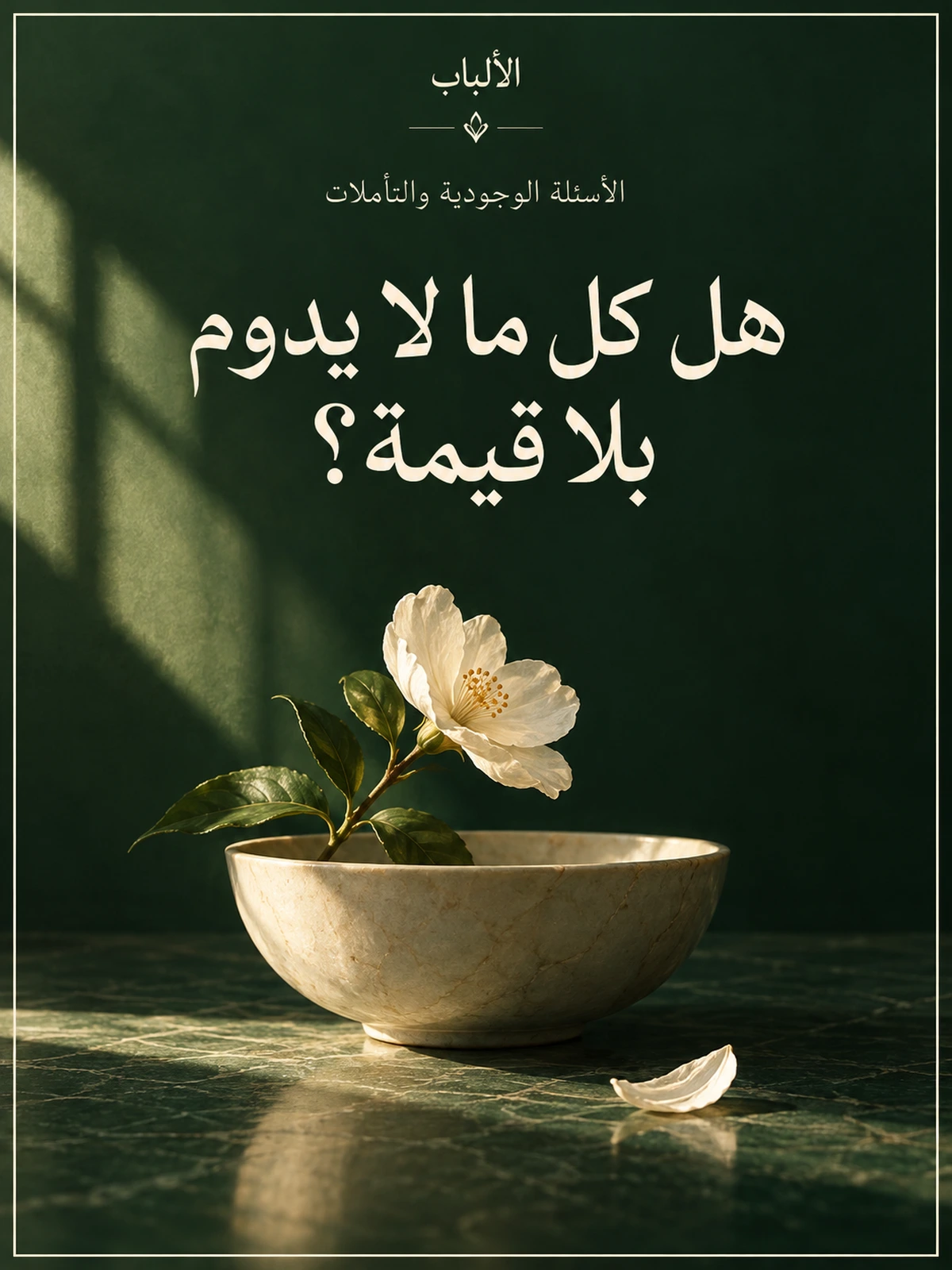
A flower that promises no permanence
This is an imagined scene: a child returns from an outing with a flower that has fallen from a branch. He puts it in a small bowl near the window. His brother says, “It will wilt, so why care for it?” The child looks at its colour and asks, “Would it be more beautiful if it never wilted?” The question settles no philosophical debate, but it interrupts a familiar inference: that something destined to end is not worth the effort we give it now.
We hear this inference in many forms. Why make a memory we will forget? Why care for a place we will leave? What is the value of a meeting that ends, a passing season, or an effort that leaves no enduring name? The question may arise from real pain rather than a wish to argue. When we lose something dear, its ending can seem to withdraw value from its beginning too. We should not answer that pain with a quick piece of wisdom demanding that its bearer see it as a blessing.
Is duration a sufficient measure of value? Does every good need a lasting effect to be good? When is seeking continuity an expression of faithfulness, and when does it become a condition that makes us reject every finite experience? How do we respect the passing of things without using it to excuse neglect? This is a reflective article about value and permanence, not a psychological explanation of loss or a prescription for overcoming grief.
1. How long something lasts does not tell us, by itself, what it is worth
An irritating noise may last a long time, while a brief moment of listening may have great value. We need no experiment to understand the logic of this example: time describes duration, while evaluation asks what happened within it, for whom, and with what consequences. Duration may matter, but it does not answer those questions alone. Continuing harm is no virtue, and brief kindness is not thereby nothing.
When we say a meeting was good, we do not necessarily mean it was good because it lasted a certain number of hours. Perhaps it allowed an apology, held sincere sharing, or gave someone a chance to speak. When the meeting ends, its temporal occurrence ends; our judgment about what happened within it need not become false. We should distinguish “It is no longer happening” from “It had no meaning.” The second statement needs an argument beyond the event’s cessation.
“for its own sake” — Original English phrase supplied in the source’s discussion of value, from “Intrinsic vs. Extrinsic Value,” Michael Zimmerman and Ben Bradley, Stanford Encyclopedia of Philosophy. Reference.
The entry introduces a distinction between what we value for itself and what we value through its relationship to another good, noting the terminology’s complexities and disagreements. We do not derive an agreed list of everything valuable from it or claim that it proves our argument about duration. We use the distinction only to ask: do I value the experience for what it was, or allow it value only if it produces something else that survives it? This does not settle every disagreement, but it prevents evaluation from being reduced to a single criterion.
We may combine both kinds of appreciation in one thing. We enjoy a conversation with a friend for its affection and may also find it useful in a later decision. Later usefulness is no fault, but the conversation need not be worthless if it produces no decision. Nor is everything we enjoy morally good; a pleasure may harm someone else. Questions of rights and harm therefore remain present, rather than replacing a worship of permanence with a worship of the moment.
2. An effect may remain, but that does not excuse inventing one
Some actions end while their effects continue: an explanation helping a learner, a repair making something usable, or care preserving someone’s dignity in a difficult hour. These are possibilities, not a promise that every action will have wide effects or its author will see them. We may not know what remains, and what we expected may not remain. Acknowledging that is more honest than guaranteeing a hidden effect for every experience in order to defend its value.
Sometimes we exchange one difficult condition for another: having required the event to remain, we begin requiring its effect to last forever. But does feeding a hungry person become less good because they will be hungry tomorrow? A recurring need does not invalidate the response given at the right time. Today’s care may be required despite knowing tomorrow will need fresh care. Help need not solve the entire future to be real help now.
“or knowledge from which benefit is derived” — The Prophet, peace and blessings be upon him; an English rendering of an excerpt from Abu Hurayrah’s report in Sahih Muslim 1631, concerning ways an action’s benefit continues after death. Full text.
The hadith mentions ongoing charity, beneficial knowledge and a righteous child praying for the deceased. We cite the excerpt in its religious context concerning continuing reward, not as experimental evidence that all knowledge spreads or every effect lasts. It directs attention to the possibility of extended benefit without licensing us to award immortality to actions whose outcomes we do not know.
We can therefore ask how to improve a possible effect without requiring an impossible guarantee. A teacher can explain clearly and be patient; someone repairing an object can work carefully; someone offering comfort can respect another’s needs. How much remains afterwards is not entirely within our control. Acknowledging limits to control does not justify neglect; it distinguishes responsibility for care from possession of the outcome.
3. Accepting an ending does not mean bringing it about early
Knowing that a relationship or thing will not last forever differs from allowing it to deteriorate because we have decided its end is inevitable. A flower may wilt quickly, yet we can water it while it lives. A place may be temporary, yet we can preserve it for those who follow us. Temporary does not mean permissible to ruin, and accepting a natural limit does not cancel the care we have undertaken to provide.
An inevitable ending does not make its cause, manner or timing irrelevant. Something passing with time differs from its destruction through neglect. Rights and responsibilities may lie between the two, and “everything ends” does not erase them. Discussion of impermanence therefore needs an ethics of care; otherwise reflection becomes a convenient argument for abandonment.
In relationships especially, “nothing lasts” is not an adequate ready-made answer to someone asking us to honour a clear promise. Circumstances may change and continuation may become impossible, but explaining the change, respecting rights and apologising for failures remain necessary as the situation requires. This article cannot judge a particular relationship; it rejects the leap from life’s limits to exemption from responsibility within it.
Valuing an experience that has ended does not mean we must reopen it. We may recognise that a period held goodness while also seeing that returning to it would be unsuitable. We can grieve an ending without lying about the harm that occurred. Appreciation is not an order to continue, and an ending is not an order to erase memory. These distinctions help describe experience fairly rather than make people’s decisions for them.
4. Shared value does not belong to one person alone
Not all value is an inner matter we carry alone. When a father reads to his child, the encounter’s value does not reside only in his memory or in how much the child will remember years later. It is also in the relationship taking place now between two people: one gives attention, and the other finds someone who listens. This is an ethical reading of the example, not a claim that every encounter leaves a permanent psychological effect.
It helps us move beyond the narrow question, “What will remain for me?” An action may deserve care because it benefits someone else, even without lasting recognition or visible gratitude. Yet this does not make sacrifice an unlimited duty: the giver has needs, and the recipient has a right not to be burdened with an emotional debt for every act of help. A relationship’s value does not justify exhausting either person.
When a shared experience ends, fairness still asks us to distinguish its ending from judgment on everything within it. We may acknowledge real goodness and also reject later harm. Recognising a kind moment need not exonerate a harmful relationship, and leaving it need not erase every good memory. This preserves the complexity of experience from a single judgment that swallows it whole.
Another view: is true value not what resists passing away?
The objection has clear force. In many matters we prefer what lasts: stable justice, security that does not collapse, and a tool that does not quickly break. Duration affects the amount of benefit and our ability to rely on something. Ignoring it altogether produces the opposite mistake, as though passing assistance equalled a continuing system of care, or a momentary promise equalled a dependable commitment.
But recognising continuity’s advantage in a particular case differs from requiring it of all value. Lasting good may be better than a similar, shorter good without the shorter being worthless. Comparing two degrees does not turn the lesser into zero. Nor do things always differ only in duration: one may continue with harm while another is brief and just. We must consider their properties together.
Another person may object that talking about finite value does not comfort someone who has lost what they love. Sometimes that is true, but it shows the argument’s limits rather than disproving it. The logical question of whether an ending erases the past’s value differs from a person’s question about what they can bear today. We should not impose an answer to the first upon the second. An idea may be reasonable while the timing or manner of presenting it is cruel.
We therefore do not tell grieving people to be grateful instead of grieving, or demand that they extract a lesson from loss. They may find something useful in the idea or have no need for it now. Respecting this is part of the argument itself: words have value through what they do between people, not through their appearance of abstract wisdom. Sometimes silent companionship is more truthful than a long proof about impermanence.
In the light of the Quran and Islamic wisdom
TRANSLATION OF THE MEANING · COMPLETE VERSE 55:26Everyone on earth will perish,Rowwad Translation Center · QuranEnc · v1.0.20 — The Holy Quran, Ar-Rahman, 55:26. Text and Al-Saadi’s commentary.
Al-Saadi explains the verse through the passing away of creatures on earth. The next verse completes the context by speaking of Allah’s abiding existence; the text should not be made a declaration that existence is futile or good and evil are equal. It is a reminder of belief concerning created beings’ limits, not a criterion declaring everything whose duration ends worthless. Connecting that meaning to everyday questions is editorial reflection and should remain distinct from commentary.
TRANSLATION OF THE MEANING · COMPLETE VERSE 16:96Whatever you have will come to an end, but whatever Allah has will last forever. And We will surely grant those who remain steadfast their reward according to the best of their deeds.Rowwad Translation Center · QuranEnc · v1.0.20 — The Holy Quran, An-Nahl, 16:96, excerpt. Text and Al-Saadi’s commentary.
Al-Saadi connects the contrast with preferring what lasts and relinquishing what harms or distracts from duty while pursuing what benefits. We do not equate this abiding with fame or a name surviving in people’s memories. Its reference is the hereafter, widening evaluation beyond the duration we observe. It does not authorise us to know individual destinies or guarantee a particular recompense for a particular deed; it directs action towards what deserves pursuit.
TRANSLATION OF THE MEANING · COMPLETE VERSE 18:46Wealth and children are the adornments of the life of this world, but the lasting righteous deeds are better with your Lord in reward and better in hope.Rowwad Translation Center · QuranEnc · v1.0.20 — The Holy Quran, Al-Kahf, 18:46, excerpt. Text and Al-Saadi’s commentary.
Al-Saadi explains enduring good deeds as including obedience, the rights of Allah and people, and forms of kindness. Evaluation therefore does not stop at the length of an earthly scene or its apparent success. We take guidance from this in distinguishing an action’s duration from its value, keeping the religious meaning clear: not every enjoyable experience becomes an enduring good deed simply because we loved it, and an action’s shortness or length alone cannot judge it.
Applications: care without a guarantee of immortality
If you find yourself saying of something good, “It will end, so it is pointless,” ask what precisely you mean by benefit. Does the thing’s nature require continuity, or have you added an unnecessary condition? A meal nourishes, a visit maintains a bond, and learning opens understanding; each has an appropriate criterion. These are examples for thought, not a new list of duties or an invitation to ignore the costs of choices.
Also ask what care you owe while something exists. If you will leave a place, how will you leave it? If a period ends, which rights remain afterwards? If you want to preserve a trace, what is a realistic way? Sometimes recording helps; sometimes it becomes an exhausting attempt to hold every moment. The aim is to choose what deserves preservation without treating what is not preserved as nonexistent, not to document all of life.
It also helps to leave grief its own language when it is present. Recognising the value of what has passed does not require immediate acceptance of its end. Both statements can be true: this was precious, and I hurt because it ended. There is no contradiction demanding urgent repair, and this article gives no one the right to demand that you move on by a deadline they choose.
Conclusion: finite does not mean nonexistent
Duration matters, but it is not the only measure. We may seek and work for good to continue, then acknowledge our limits without denying the value of what was achieved. We may preserve an effect, uphold a right, or let something go without making its ending an indictment of everything before it. The aim is responsible care, neither surrender to neglect nor a promise of immortality.
In the imagined scene, the colour will one day fade. The child may feel sad for a while and then turn to something else. The bowl was no contract with eternity. It was room for possible care for something finite. Between knowing the ending and refusing all care lies a space ethics can inhabit.
Questions that stay with us
Do I make duration the only criterion of value? What distinguishes accepting an ending from neglect that hastens it? Do I demand a lasting effect from every experience before acknowledging it? How can I care for what is finite without promising myself it will remain?