

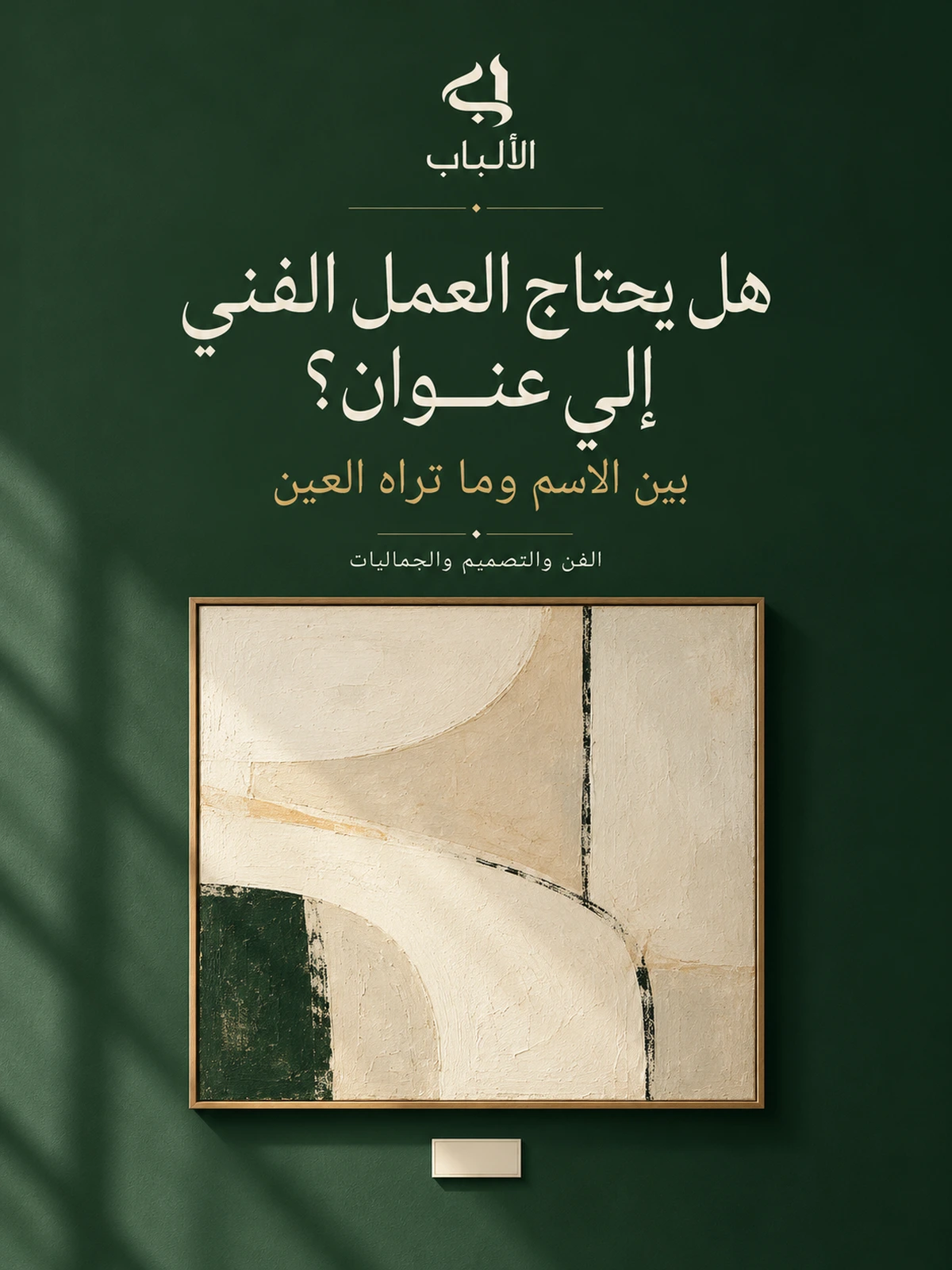
A small label beside the painting
This is an imagined scene: a visitor stands before a painting with a blue area and a slanting white line. She sees a window; her companion sees a road in the rain. They read the small label: “Return.” Suddenly she begins looking for a house and he for a traveller. Neither the colour nor the line’s direction has changed, but a new question has entered between the eye and the surface. Have they discovered a missing meaning, or allowed one word to direct the entire viewing?
This article reflects on the function of titles; it is not an experimental study measuring their effect on every viewer. We use documented examples from museum collections, distinguishing what records say from our proposed readings. A title can help us encounter a work, but it can also make us announce too quickly that we understand it. Between assistance and haste lies a space worth pausing over, like the small gap between label and frame.
Questions to begin with
- Does a title tell us what we see, or suggest a way to see it?
- What does “Untitled” mean when written where a title belongs?
- When do words become part of the work itself?
- How can we benefit from the artist’s explanation without attributing all our feelings to them?
A name that opens a door
Imagine a photograph of an empty chair before a door. Called “Rest,” it may draw your attention to the absent body’s comfort. Called “Waiting,” it may make you look for someone who has not arrived. These hypothetical titles are not psychological research findings. The example illustrates possible differences in the question we bring to the image, without proving every viewer will feel the same. A third person may remain interested in the chair’s wood or the angle of light, unconcerned with the suggested story.
A title has a practical function before any philosophical one: helping us refer to a particular work, discuss it and find it in a record. “The blue painting” might mean many works. Even in cataloguing, a name does not work alone; it may need the artist’s name, date and collection number. We should not ask a short title to carry everything distinguishing a work or replace descriptions of its material, size and context.
A name may describe what appears or point to what does not. The latter need not mean the artist is deceiving us. Perhaps it suggests a relationship between visual experience and another experience, as metaphor does in language. Still, we should distinguish what we observe in the work from the story we build around it. “I see a chair” is a different kind of statement from “I feel its owner will not return.”
The Art Gallery of South Australia documents Whistler’s use of the musical term “nocturne” for his works. It quotes him:
“A nocturne is an arrangement of line, form and colour first” — James McNeill Whistler, original English supplied in the source metadata, as quoted in the museum record.
This does not invite us to hear literal sounds inside the paper. It allows thought about the organisation of elements before searching for an event narrated by the image. We can therefore suggest an editorial question: does the name help us see relationships between parts, or make us look only for what resembles the word’s meaning? No single answer is required for all works. Some titles succeed by guiding; others by leaving an unresolved tension.
When a work chooses not to tell a story
In its record of Whistler’s Nocturne, the Los Angeles County Museum of Art explains the title’s connection to reducing external narrative. It quotes the artist saying:
“I wished to indicate an artistic interest alone” — James McNeill Whistler, original English excerpt supplied in the source metadata, as quoted by LACMA from its reference published in 1995.
We make the route of quotation explicit: we have not reviewed the artist’s original letter. Nor do we turn the excerpt into a law for all art. Its value is in opening another possibility: an artist may use a word to reduce viewing’s dependence on words and stories. Here the title supplies no keys to hidden characters; it asks us to look at what line, colour and composition do.
A subtle difficulty appears. When someone asks us to look at form alone, they have already given us linguistic guidance. We cannot claim to have reached pure viewing preceded by nothing. Recognising that does not make viewing impossible; it makes it more modest. We know we carry a suggestion, test what it helps us notice, then ask what it leaves outside our attention.
A title can resemble a companion who knows the place and points out a detail we missed. The problem begins if the companion talks throughout the visit until we see nothing for ourselves. This is our metaphor, not a saying attributed to Whistler. It helps explain how interpretation can be useful without exhausting experience. We can read the label, return to the surface, and read the label again with a more precise question.
Historical information is not thereby superfluous. Ignoring context may lead us to misunderstand a material, function or circumstance of production. Each piece of information should have its appropriate task: history helps locate the time, a title may guide interpretation, and description clarifies what is displayed. Combining these functions into one sentence makes it easy to mistake knowing a work’s name for knowing the work.
Untitled does not mean empty
The Museum of Modern Art displays Donald Judd’s Untitled, dated 1968 and made of painted steel. The absence of a descriptive title does not show that the artist did not care about the work or that its meanings are entirely unrestricted. Material, arrangement and place can be considered before inventing a story about the artist’s personality.
The museum label quotes Judd:
“Actual space is intrinsically more powerful and specific than paint on a flat surface” — Donald Judd, original English statement from 1965 supplied in the source metadata, as quoted by the Museum of Modern Art.
We cite this to understand a declared interest in space and material, not to prove sculpture superior to painting. The museum label offers an explanation for leaving that work untitled; this remains a particular museum interpretation, not permission to attribute the same motive to every artist using the same phrase. A similar word in two catalogues may conceal entirely different decisions.
For our part, we can reflect on “Untitled” as a pause before the wish to name everything immediately. It does not erase language: we still read a phrase and use it to search the website. We may even need the date and material to distinguish this work from another bearing the same phrase. Refusing an imaginative name and needing practical identification can thus coexist without necessary contradiction.
Perhaps a missing title troubles us because it denies us a ready-made sentence to repeat. We stand before the object and say, “I do not know what it means.” That can become the beginning of description: what appears? How do the parts relate? Where does the eye move? These are not exam questions with answers hidden in the curator’s drawer. They prolong the encounter a little before judgment, while acknowledging that it may produce no admiration.
A serious objection: does this complicate what should be simple?
A reader may say that good work should speak for itself and obscure names protect weak work from criticism. The objection contains an important truth: exhibition language should not become immunity from questioning. Eloquent text may promise depth that we find no trace of in the experience. Viewers have the right to ask how the description relates to the work and to remain unconvinced.
Yet requiring every work to be understood without context is also a broad condition. We do not ask every book to dispense with knowledge of its language and history. A fairer question concerns what explanation adds: does it reveal an observable detail or merely demand submission to the speaker’s status? We can benefit from guidance and disagree with its conclusion. Freedom here means refusing to let knowledge replace looking, rather than rejecting knowledge.
When words enter the image
A label beside a work differs from words written inside it. Magritte’s painting recorded by LACMA as The Treachery of Images shows an image of a pipe with a French sentence beneath:
“This is not a pipe.” — René Magritte; English rendering of the French phrase “Ceci n’est pas une pipe” inside the 1929 painting, documented in the work’s record.
The sentence is inside the painting, not merely our comment on it. A direct reading of the paradox can distinguish an image of a thing from the usable thing itself. The work’s title adds another level of thought about representation and reality. We do not claim this reading exhausts the painting or use it to argue that every title changes a work in the same way.
The example invites distinction among three layers: what makes the image, what is written in it, and what the work is called in the record. Sometimes the layers cooperate; sometimes they create tension. Translating a work into Arabic adds responsibility. We can explain that a name is an editorial translation and preserve the original in the reference, rather than present one linguistic choice as the only possible version.
A visitor’s proposed title also differs from republishing it as the authorised title. The first is a personal experiment; the second is information requiring verification. If the visitor in our opening scene calls the painting “Window,” that belongs to her conversation about it. The museum label does not automatically change because she likes the name. Respect for imagination does not cancel respect for the record, just as respect for the record does not prohibit imagination.
A small experiment for eye and language
Choose an available work to view and read the terms governing use of its image before republishing it. Look first and write a short description without a story about the artist’s intentions. Then read its title and information and note what changed in your questions. Do not record the change as proof the title deceived you; it may have helped or changed nothing. This is an individual reflective exercise, not a scientific test.
In a small group, each person can describe what they noticed before proposing a name. Then compare: which descriptions point to a visible detail, which narrate personal responses, and which make historical claims? This separation makes disagreement calmer. We need not make everyone feel the same, but can ask everyone to identify accurately the kind of statement they are making.
In the light of the Quran and Islamic wisdom
TRANSLATION OF THE MEANING · COMPLETE VERSE 17:36Do not follow[1] that of which you have no knowledge. Indeed, the hearing, the sight, and the heart, all of them will be called to account.Translation notes: [1] i.e., do not say or assume.Rowwad Translation Center · QuranEnc · v1.0.20 — The Holy Quran, excerpt from Al-Isra, verse 36; text and Al-Saadi’s commentary.
The verse appears among ethical injunctions and mentions responsibility for hearing, sight and the heart. Al-Saadi explains the prohibition through careful verification of what one says and does. We do not make it a theory of painting titles or derive a universal ruling on all arts from it. Our proposed connection is editorial and ethical: moving from “This is what I felt” to “This is what the artist intended” moves into a claim requiring knowledge.
Reflection can be expansive while attribution remains precise. An image may remind us of an old home, but that does not prove the artist painted our home or intended an experience like ours. Honesty preserves both spaces: free response and information requiring support. Respect for the work and its maker may begin with this simple separation.
Wisdom also appears in the manners of disagreement. We need not mock a reader helped by a title or accuse someone who loved the work before knowing it of shallowness. Each can describe their path without making it the only one. What we do not know does not demand total silence, but invites honest wording: I think, I see, the record reports, or I do not know.
A title that accompanies us without replacing us
The visitor returns to the blue painting in the imagined scene. She now knows it is called “Return,” but need not find a hidden traveller. She can ask what the word added, then look at the white line as it is. She has neither lost the title nor handed it her eyes. It has become part of the encounter, not a conclusion that closes it.
An artwork may need a title to circulate in discussion, or choose one to propose a relationship or resist a ready-made story. It may remain “Untitled” yet be identified by material, date and place. The richer question is not whether we should abandon names altogether, but how to accompany them: read them seriously, test what they open, and leave the work a chance to surprise us beyond them.
Questions to take with you
- Have you ever loved a work before its title changed how you saw it?
- What can you describe before discussing its maker’s intention?
- Do you treat “Untitled” as an invitation to look or as an end to conversation?
- Which title have you proposed and perhaps later confused with the original?