

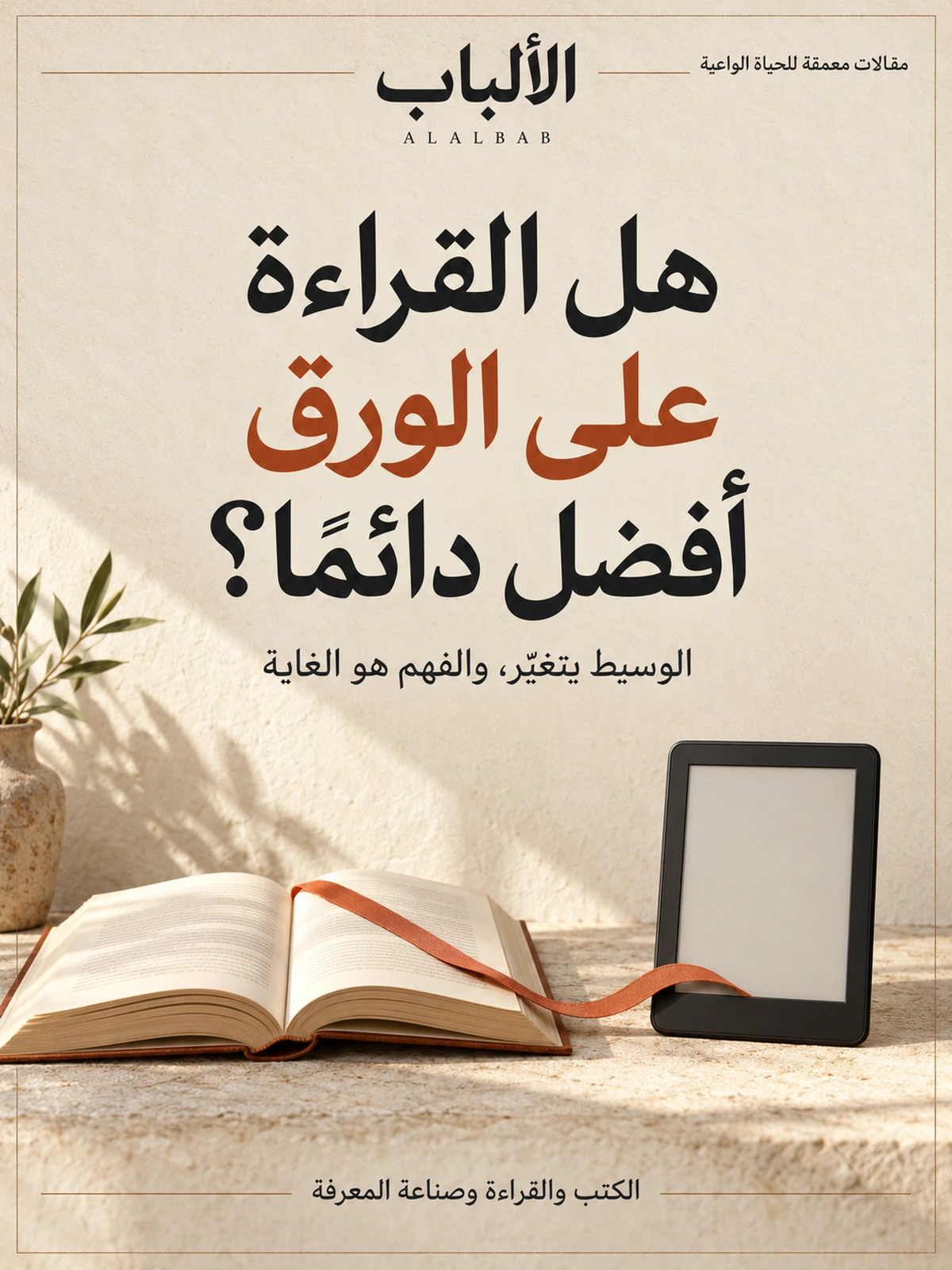
Introduction: Two Books on One Table
In this imagined scene, Maryam sits one evening with a text chosen for her reading club. A printed copy borrowed from a friend lies on the table; a digital copy of the same book is on her device. She starts on-screen because she can enlarge the letters, then moves to paper to revisit two paragraphs together. Soon a message arrives. Putting the device aside, she says, “I knew real reading only happens in a book.” Yet she remembers that the digital edition made obtaining the text possible in the first place, and that she read many printed pages while thinking about tomorrow’s work.
The scene proves neither medium superior. It shows how judgements mix several things: visual comfort, familiar movements, surrounding noise, access, task type, and the self-image we enjoy while reading. We may thank paper for quiet created by closing a phone, or blame a screen for difficulty caused by poor formatting. Material and presentation may also have real effects; saying everything depends on willpower is insufficient.
Behind paper versus screen lies fairness: how can we take research seriously without judging readers’ worth? How can we love printed books without making the owner of a large library closer to knowledge than someone reading on an old phone? The answer begins by defining what we want to improve, not choosing a camp.
- What does “better” reading mean: understanding an argument, remembering details, or enjoying time with a text?
- Do studies compare paper and screen alone, or also different ways of displaying words?
- When does an average paper advantage matter to our decision, and when is it insufficient for judging one reader?
- How can we choose a medium supporting understanding while remaining accessible in our circumstances?
1. Before Comparing: What Do We Ask of Reading?
Someone opening a manual to locate a button does not read like someone reading a history chapter. The first needs a quickly accessible answer; the second connects events, causes, and objections. A third may approach a poem to let a phrase dwell inwardly without intending to memorise it. Placing all purposes under “reading” turns success in one into an unjustified certificate of superiority in the others.
Three layers therefore deserve distinction. Access: can I obtain the text and open its pages? Interaction: can I see letters, navigate, and return to an earlier point? Meaning: do I understand the author’s claim, how it is reached, and what remains questionable? A medium may succeed at one layer and struggle at another. An instantly available scanned file with tiny type is not a good digital experience simply because it is free; beautiful printing serves no knowledge function for someone unable to acquire or carry it.
Comprehension itself exceeds word recognition. You may repeat a conclusion without its reason, or remember a vivid example while forgetting the limiting exception. Claiming to understand an article on education can prompt questions: what problem does it address, what is its central argument, and what sentence prevents generalisation? These concern your relationship with the text, not cover colour or completed pages. They invite reflection, not a standardised diagnostic test of abilities.
Pleasure is no mistake to correct. Paper has texture, weight, and memories; a device has lightness and companionship on long journeys. We may choose what we love without constructing a larger scientific argument than our preference bears. “I love printed books” is honest and sufficient. “Digital readers do not understand” adds a claim needing evidence and ranks others without justification from personal desire.
Problems arise when an experience is measured by a question designed for another. A screen may provide quick access to a name or definition, but finding a phrase quickly does not mean understanding context. Paper may help follow a chapter’s structure, but locating a sentence does not validate an inference. Tools offer possibilities; honest reading begins by using the one suited to the task.
Before opening a book or buying a device, write a small purpose: “I want to understand this disagreement,” “I need the procedure,” or “Tonight I read for pleasure.” This does not make reading administrative work. It prevents judging a poetry evening by revision standards or treating examination material like casual browsing. Purpose may change while reading, and we may change medium or pace rather than defend an initial decision.
2. What Do Studies Say, and What Do They Not?
Research evidence deserves consideration. Pablo Delgado and colleagues’ 2018 review gathered studies comparing similar texts on paper and digital devices. It found a small average paper advantage, clearer under time limits, appearing with informational or mixed informational-narrative texts but not in the same way among studies using narrative alone. This does not say every printed book is better understood; it identifies a pattern and conditions within included studies.
“The paper-based reading advantage increased under time constraints compared with self-paced reading.”
Virginia Clinton’s 2019 review, covering thirty-three experimental studies, found a small paper advantage in reading performance, mainly for expository texts, with no apparent difference for narrative. Readers’ assessments of performance were more accurate on paper on average. Yet the review found no reliable difference in reading time. It should therefore not be reduced to screens always making us faster or slowness alone explaining every difference.
“No reliable differences in reading time were found.”
Virginia Clinton-Lisell and Christine Litzinger’s 2026 study adds important detail. Their network meta-analysis compared paper with device types and distinguished scrolling from non-scrolling displays. Where scrolling was unnecessary, no reliable differences appeared between paper and studied devices. However, most studies involved university students and scientific English texts, and scrolling was classified with a simplified binary distinction. These limits prevent automatic transfer to every age, language, and design.
“Not all digital reading is the same.”
“No reliable difference” does not prove perfect identity. It means that analysis did not establish a dependable difference under available conditions and data. “A small average advantage” means neither an always trivial difference nor a guaranteed improvement for everyone. An average effect may matter for broad educational policy while failing to describe a reader with particular needs, another device, or more time.
Reviews may also share original studies. Mentioning three reviews is not the same as three wholly independent bodies of evidence. Inclusion criteria, calculations, and task definitions differ too. Honest research reading means more than counting supportive titles; it means knowing what was compared, with what, among whom, by which measure, and under what conditions.
From these limits comes cautious guidance: for dense expository material when paper is easily available, there is reasonable cause to try it, especially under time pressure. Digital reading gives reason to attend to formatting and navigation. Neither implies that changing medium solves difficult language, missing background knowledge, or unclear writing. Different problems need different work.
3. Screens Are Not One Thing, and Paper Is No Guarantee
Imagine three displays of the same text: a clean digital page with comfortable type, a photograph of two pages requiring constant zooming, and a website crowded with headings, windows, and advertisements. All are screens, but demand different effort. When saying “I did not understand on my phone”, describe the actual experience: did the idea escape us, or did we lose our place each time we returned to a paragraph’s start?
The research gives reason to examine scrolling, but mechanism exceeds mere movement. Scrolling differs in length, speed, and ease of returning. As design suggestions, not settled findings for every reader, ask: can I see the section heading? Do I know where reasoning ends and objection begins? Can I compare two paragraphs? Practical questions are more precise than declaring the phone thought’s enemy.
Paper can also be badly designed: tiny type, cramped spacing, confusing margins, and missing references can make a printed book difficult. Noticing flaws does not deny love for books. Respecting reading requires evaluating an edition’s quality, not just material. A clear digital edition may be practically preferable to unsuitable printing without cancelling research comparisons.
Text also differs from its surroundings. A reader leaving chats open and comparing that session with a quiet paper hour has not isolated the medium’s effect. Reading paper beside a running television does not create concentration merely because the computer is closed. When many things change together, assigning the result to one is difficult. This simple methodological caution does not demand a home laboratory, only avoiding rushed explanations.
It helps to distinguish possessing a text from possessing a route back to it. Hundreds of files may leave you unsure which edition you read; many printed annotations may leave you unsure why they mattered. Quantity alone does not turn an archive into knowledge. Digitally, name files clearly, preserve edition details, and note an idea worth revisiting. On paper, record page and reason for interest rather than underlining every attractive line.
Consider an imagined discussion of a history chapter. One participant recalls a sentence found through in-book search; another recalls its location near the chapter’s end. Both have useful retrieval keys, but finding it does not end discussion. They must read around it to determine whether it is the author’s view or an opponent’s quoted position. Search speed and page location are means; fidelity to context is a shared task.
A single task may involve two media. Search digitally for relevant chapters, read a printed chapter carefully, then return digitally to check recurring terminology. This is a proposed route, not a universal prescription or a method proven superior everywhere. Its value is freeing us from treating a switch as betrayal of an earlier choice. The tool may change as the task changes; our criterion remains what it enables clearly.
A difficult reading session need not prompt an immediate purchase. Choosing a better edition, enlarging type, closing unnecessary material, or using a clear contents page may suffice. These are changes worth trying with available tools. A promise that one device will create a deep reader exceeds both the evidence presented and the tool’s responsibility. Depth does not arrive boxed with a guarantee, although design can support it.
4. Access and Choice: For Whom Is Reading Possible?
“Asking which is better” may assume a reader possessing both copies, a quiet desk, sufficient time, and the ability to read standard print. Many lives offer no equivalent alternatives. The choice may be an available digital book versus a printed one unavailable locally, enlargeable letters versus uncomfortable print, or an already-carried device versus volumes difficult to carry daily.
Accessibility therefore belongs centrally in the decision. The World Wide Web Consortium’s Web Accessibility Initiative explains text resizing and notes that some people can only read larger text. This is guidance for usable design, not evidence that screens improve comprehension. It reminds us that beginning to read is a precondition for comparing reading’s outcomes.
“Some people can only read text when it is larger.”
An average advantage should not justify removing a medium a particular reader needs. If they can follow enlarged text on-screen, saying paper performed better in some tests does not compensate for an unusable edition. Responsible questions concern improving their medium and understanding actual need without stigma or treating them as an inconvenient exception.
Conversely, accessibility should not become a slogan for removing everyone’s paper alternatives. Some students may need them, or paper may provide more stable access in their environment. Fairness does not mean imposing a supposedly universal medium, but explaining educational requirements and providing reasonable alternatives where possible. This is an editorial ethical recommendation drawn from the problem, not a universal law automatically derived from one experiment.
Publishers’ responsibility matters alongside readers’. A digital book lacking chapter navigation or displaying Arabic incorrectly is not modern merely because its file is electronic. A printed edition obscuring sources or dividing paragraphs poorly gains no intellectual privilege from its scent. We can value craftsmanship in both and demand complete, clear text, accurate attribution, and traceable references.
Within families, discussion may judge appearances: someone carrying a book looks like a reader; someone holding a phone looks distracted. Either may be occupied elsewhere. This does not make every phone use reading; appearance alone does not identify activity. Instead of accusatory “Why are you on a screen?”, ask about the text: what is its idea, and what interested you? Meaning then precedes monitoring the image.
A Serious Objection: Does This Flexibility Minimise Paper’s Advantage?
A reader may say flexibility sounds kind but weakens a useful finding: if paper leads in several comparisons, why not make it the default for difficult texts? This objection has force. We should not drown in exceptions until pretending evidence guides no decision. Where cost and access are comparable, evidence can indeed favour paper for careful expository reading.
A default nevertheless remains a revisable starting point, not a final ruling on every case. Its strength is providing a reasonable initial choice; its weakness arises when it blocks sight of contrary conditions. A need for enlarged type, a clearer and more complete digital edition, or a task searching for specific information changes the balance. Respecting evidence includes respecting its question rather than making it answer another.
The opposite objection asks whether everyone should simply choose what feels comfortable. Comfort matters for continuation but is not always a measure of understanding. Text may be easy to navigate yet difficult in meaning, and familiarity may be felt without an ability to explain the argument. Preference can coexist with a modest check of outcomes. We neither exclude readers’ feelings nor make them sole witness and judge of a specific intellectual purpose.
Practical Applications: A Small Trial before a Large Decision
Begin with one task, not a plan to change your entire life. Choose a chapter needed this week and define success: explaining its idea to someone, distinguishing two arguments, or locating a passage for work. If pleasure is the aim, allow it without apology. Clarity helps select a medium and judge whether the experience actually helps.
Improve conditions within your control. Digitally, check legibility, returning to earlier points, contents or numbering, and close unnecessary windows where possible. On paper, choose comfortable lighting and position and keep references traceable. These are general organisational suggestions, not claims to erase research differences or replace specialist help for persistent difficulties requiring assessment.
After a meaningful passage, pause: what does the author establish, with what evidence, and within what limit? Answer in your own words, then return to the text. If something is missing, identify it before declaring the entire medium a failure. Did you need a definition, an earlier paragraph, or more time? Practical diagnosis here describes an obstacle, not a person or disorder.
If comparing paper and screen personally, make it a modest observation rather than an experiment settling science. Use texts of similar difficulty and purpose, attend to time, fatigue, and familiarity, and record what helped or obstructed. Rereading the same text in another medium brings prior exposure, so do not attribute all improvement to the new medium. Even careful observation remains guidance for a limited personal decision, not a universal rule.
You might set a flexible two-week rule: read digitally when searching is needed, try paper for sustained reading, then review. Do not impose schedules or tools that do not suit you. The idea is purpose-led, revisable choice. Perhaps the best outcome is recognising when to pause and return, whatever page is before you.
In education, tasks can clarify what is expected at each stage. Comparing two arguments should not consume most effort in discovering how to open or revisit the text. Before an important digital assessment, familiar interfaces and clear navigation help. These concern procedural fairness, not a claim that training alone removes medium effects. The goal is distinguishing content difficulty from access difficulty as far as possible.
Choosing an edition for a group requires more than majority preference. Gather specific observations: is type size problematic? Do links work? Is offline access possible? Do page numbers align, or is there a shared way to identify paragraphs? Some problems need an improved edition, others an alternative. In discussion, section titles and opening words can help readers using different editions cooperate.
Caring about medium does not require tracking every minute or testing every session. Measuring reading may crowd out reading itself. A brief review when a real problem or recurring decision arises may suffice: does this format suit this kind of text? Then return to the book. A helpful rule reduces friction with meaning; if it becomes constant self-monitoring, simplify it. We choose means to support reading, not read to prove our chosen system works.
In the Light of the Quran and Islamic Wisdom
The Quran places reflection and remembrance at the heart of relationship with revelation. God says:
TRANSLATION OF THE MEANING · COMPLETE VERSE 38:29This is a blessed Book that We have sent down to you [O Prophet] so that they may reflect upon its verses, and so that people of understanding may take heed.Rowwad Translation Center · QuranEnc · v1.0.20.
The verse concerns the Quran and the purpose of its revelation, not a cognitive comparison of screen and paper. It appears in a context affirming creation’s wisdom, justice, and recompense, as Ibn Kathir explains. It should not certify either medium scientifically, or the word «كتاب» be used to derive a judgement on modern reading technologies. Distinguishing the text’s meaning from our contemporary question respects the text itself.
The educational inspiration proposed here redirects attention from eyes merely passing over words towards present understanding. This connects reflection with reading habits; it is neither a new interpretation nor an equation of reading revelation with other books. Human books still require verification and criticism: authors may be right or wrong, and our duty does not end with attractive print or easy presentation.
The Quran also recalls responsibility in knowledge and speech:
TRANSLATION OF THE MEANING · COMPLETE VERSE 17:36Do not follow[1] that of which you have no knowledge. Indeed, the hearing, the sight, and the heart, all of them will be called to account.Translation notes: [1] i.e., do not say or assume.Rowwad Translation Center · QuranEnc · v1.0.20.
The verse connects this prohibition with responsibility for hearing, sight, and the heart. Ibn Kathir explains the prohibition of speaking without knowledge and relying on conjecture. Here the practical value is clear: do not claim a study proved what it never examined, say we read a whole text because we located one line, or attribute a view before checking its place. These are proposed ethical applications, not experimental results extracted from the verse.
This discipline may be especially needed when a claim agrees with our preferences. Paper lovers may cite a study title and forget its limits; technology lovers may select a null result and ignore others. Intellectual integrity requires presenting what limits our view as seriously as what supports it. Reading becomes practice in fairly presenting positions, not merely enlarging a stock of phrases defending our choices.
Making knowledge accessible to others also deserves everyday expression: lending a book, pointing to a clear authorised edition, or helping a reader adjust a display. They need not choose our medium for their pursuit to be taken seriously. Care for the reader broadens love of books and prevents it becoming guardianship of one way to approach meaning.
Conclusion: Choose the Page That Helps You Meet Meaning
Return to Maryam in the imagined scene. She need not apologise for loving paper or defend the device that made the book available. She can close messages, choose the edition suited to the chapter, revisit an unclear passage, and ask what she understood. The evening need not end in a ruling on reading’s future, only a more honest relationship with one text.
Studies give reasons to respect paper’s average advantage in some comprehension tasks, and to attend to differences among texts, devices, and presentation. Evidence does not choose for every person; it enters a decision including access, purpose, time, and edition quality. Distinguishing these factors reduces slogans and improves an actual experience.
Today’s helpful page may be paper to turn or a screen with enlarged letters. Both leave work the material cannot perform alone: doing justice to an argument, verifying attribution, and knowing where understanding ends and questions begin. The medium deserves care because meaning does. Care for either is incomplete if we forget the person trying to reach the other.
Questions to Carry with You
- What purpose guides your reading-medium choice at this stage?
- Do you know the obstacle interrupting understanding, or habitually blame paper or screen before examining it?
- How do you distinguish reading comfort from the ability to explain what you read?
- What small change could make text clearer and more accessible for you or someone else?