

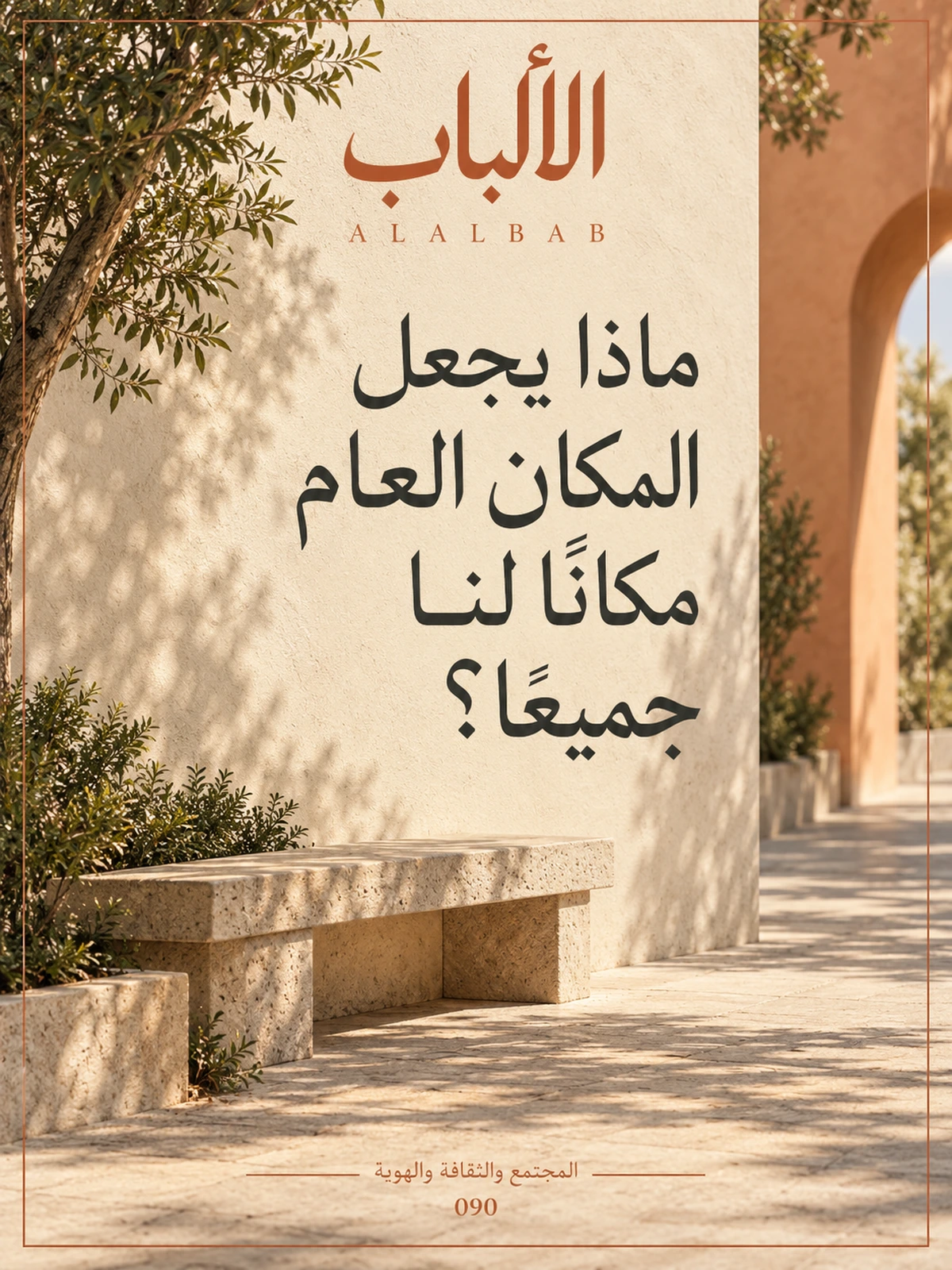
A Bench That Does Not Ask Your Name
In this imagined scene, an older woman reaches a new neighborhood square. She sees young trees, clean paving, and a fountain shining in the municipality's photograph. But the only remaining bench is in the sun, the bus stop farther away than expected, and toilet signs unclear. She pauses and leaves. An hour later, a young man there tells a friend, “At last, we have somewhere beautiful.” Neither lies: they describe one place from different bodies and different needs for time, rest, and safety.
Near the fountain, a café lets the young man buy a drink and stay, while a worker calculates needing that money for the return journey. A child wants to run, a reader wants quiet, and a wheelchair user discovers two steps at the shortest route's end. These are not faults diagnosed in a particular city, but a thought experiment revealing what attractive photographs conceal: a place can be open without being equally usable.
We call streets, parks, and squares “ours,” but the collective pronoun needs testing. Does it mean legal ownership or dignified presence? Is entry freedom enough when remaining depends on buying, enduring discomfort, or requesting help? How do we organize conflicting needs for rest, play, work, and passage? Whose voice should define success?
This explanatory article addresses public-space ethics, design, and management, not field research on a city. It draws on a primary international text, a UN goal, a professional framework, and documented religious texts. Scenes, comparisons, and proposed applications are editorial analysis, not experiments or causal measurements. These levels matter: agreeing on a fair goal still leaves testing how our actual street can achieve it.
1. Publicness Is a Relationship of Use, Not an Entrance Sign
Public places have overlapping layers: ownership, management, admission conditions, and what visitors can do once inside. State-owned land may be difficult to use because of fencing or narrow hours; private bodies may permit passage on stated conditions. Appearance or ownership alone cannot establish publicness. Ask practically who may be present, for what purpose, at what cost, and who can change those conditions.
Distinguish entry from the opportunity to remain. An open park gate permits the first; the second needs seemingly small details: rest, understandable routes, and presence without having to justify oneself. Every square need not offer every service, but should not claim untested inclusiveness. A play square may succeed while still needing connections to quiet space or a suitable through-route.
“Safe, inclusive and accessible green and public spaces.”
The target sets universal access on a 2030 horizon, emphasizing women, children, older people, and people with disabilities. It is a declared normative goal, not certification of achievement. Its value here is resisting reduction to park counts or attractive paving: safe, inclusive access belongs within the desired definition of success, not decorative additions afterward.
Imagine equal-sized squares. In one, passersby can drink their own water and sit without buying; in the other, commercial tables occupy most comfortable spots. The latter may be economically livelier and offer popular services, but equal area does not mean equal benefit. The objection is not the café's existence but consumption becoming the only recognized language of presence. Shared space needs room for visitors who are not necessarily customers.
Some costs do not appear on tickets: feeling constantly suspected or being asked to explain sitting while others are left alone. Impressions alone cannot establish discrimination in a specific place; facts, rules, and comparison of enforcement are needed. But the possibility shows why doors alone do not measure publicness. Design questions should include staff instructions, complaint handling, and stated limits on removing visitors.
Not every use is permissible. Groups should not monopolize passages; fountains are not necessarily safe play spaces; sitting grants no right to disturb. Publicness is mutual: you have a place, and others' places do not disappear because you arrive. It means not absence of boundaries but boundaries explainable through common benefit, rather than favoring those resembling decision-makers or better able to pay and object.
2. The Body We Forget in the Drawing
A straight route from gate to bench may imagine a person walking steadily, seeing signs, hearing alerts, and never needing to stop. This convenient design user does not represent every body. The same person changes: carrying a bag today, pushing a pram tomorrow, recovering from injury next month. Recognizing difference does not divide normal people from exceptions; actual use is more diverse than simplified models.
“On an equal basis with others.”
Article 9 covers access to physical environments, transport, information, communications, and publicly available facilities and services, linking access with identifying and removing barriers. This presents treaty content, not a local legal judgment on a facility. Our practical inference is that access forms a chain: arrival, entry, movement, use, and departure. One successful link cannot compensate for the next being broken.
A doorway ramp may be reached only between parked cars. A wide passage may have unclear signs. A bench may be reachable but the intended service inaccessible. These are hypothetical examples, not engineering diagnoses. Dimensions, slopes, materials, and safety requirements belong to specialists using applicable standards. The ethical question prevents declaring access complete from one photographed “adapted facility.”
Assistance is not always equivalent to independence. Generous help is useful and sometimes necessary, but repeated reliance on whoever happens to be available changes experience. Independent visitors choose timing; those waiting for a keyholder or employee may alter plans. Ask users' preferences rather than assuming enthusiasm to help excuses examining the barrier that made help necessary.
Time matters too. A place usable in mild weather may become difficult in heat; an empty route may become complicated during events. One comfortable visit cannot establish quality. Fairer assessment considers different times and ordinary conditions. Do not expose people to harmful tests to prove barriers; describe and document safely with technical expertise and lived experience.
Participation can reveal hidden assumptions. Designers may expect everyone to prefer shortest routes while some need longer routes with rest. Another sign may seem sufficient when conflicting directions are the problem. One person's testimony represents neither all disabled nor all older people, but cannot be dismissed for contradicting the drawing. Good listening treats experience as evidence of a question needing examination, not an opening-day nuisance.
3. Beauty That Allows Life
Judging a cleaned square before people arrive is easy: balanced lines, empty benches, nothing disturbing composition. Public places serve another moment: shopping bags, prams, conversations, fatigue, and waiting. If the image cannot accommodate ordinary use, the beauty criterion may be incomplete. The aim is not glorifying disorder but including expected life in our idea of order.
“Are there enough places to sit?”
The organization's framework considers access, comfort, activities, and sociability through practical observation questions. It is professional guidance, not a randomized experiment proving that adding benches necessarily creates friendship or health. It organizes attention while context still needs checking: a bench may help here, obstruct an essential route there, or require protection and maintenance first.
Useful beauty offers choice. It neither forces everyone into one gathering nor treats solitude as social failure. Someone may read alone near others; someone else seeks company. Between full participation and home isolation lie valuable degrees: familiar faces without conversation, watching a game from afar, resting without performing a role. These are human values worth attention, without claiming measured psychological effects for every visitor.
Shade illustrates symbolism versus use. A lovely young tree may not yet cast enough shade; an impressive canopy may cover an unused spot. Actual climate, season, and hour require examination, alongside maintenance and safety. No recipe fits every city, but a useful habit asks what an element does for people during use, not merely for pictures.
“Vitality” should not demand constant noise. Many events delight some while preventing others visiting during available hours. Distributing activity across space and time may be fairer than one pattern everywhere. Quiet is not older people's monopoly or play children's alone; every category contains diversity. Clear alternatives beat stereotypes about age, gender, or cultural preferences.
Opening excitement often forgets who will care for everything a year later. Bins need emptying, trees care, lights repair, and paths attention. Without maintenance costs in decisions, beauty becomes temporary promise. Volunteering should not cover absent accountability. Residents can contribute but need to know who controls repair tools and budgets and where to turn for problems beyond them.
4. Who Speaks for “Everyone”?
When authorities announce residents' satisfaction, politely ask which residents were heard. Evening attendees need not represent everyone; online respondents do not automatically represent nonusers. People who never visit may offer the best explanation of absence. Asking only those present resembles judging a doorway by people who passed through while forgetting those who turned back.
Participation does not require planning expertise. People can describe precisely where they stop, when they avoid visits, and what makes a route difficult. Specialists should translate descriptions into testable options and explain what is possible, what is not yet possible, and why. Consultation that gathers stories then disappears leaves participants unsure whether they influenced anything or decorated a predetermined decision.
Listening does not mean implementing every request. One group wants sport, another restrictions on fast movement, while passersby need a continuous route. Fair questions concern basic needs, separation or rotation, and harm not silently imposed on one group, rather than who is angriest or loudest. Solutions may involve scheduling, redesign, or refusing requests that erase others' use.
Where safe and permitted, test small scenarios before generalizing: temporary bench arrangements within professional plans, activity times, or better signage followed by monitoring questions. Specify what is to be learned beforehand, or trials may select only pleasing impressions. Is passage clearer? Did the problem move elsewhere? Did maintenance take unbudgeted time? These are follow-up questions, not success guarantees.
Observation must not violate privacy. Count uses or describe barriers without faces or unnecessary names. Participation should be voluntary and purposes simply explained. A welcoming place should not turn visitors into undisclosed surveillance material. Good knowledge gathers enough to understand while preserving the dignity of those helping provide it.
Fairness lets someone object without being accused of hating development. Specific criticism can express care: “This entrance is difficult” is not “The project is a failure.” Success in one feature does not invalidate complaints about another. Leaving total praise versus total attack lets us protect achievements and repair shortcomings. “Everyone” then becomes an ongoing commitment to widen hearing rather than a comprehensive claim.
5. In the Light of the Quran and Islamic Wisdom
TRANSLATION OF THE MEANING · COMPLETE VERSE 49:13O people, We have created you from a male and a female and made you into nations and tribes so that you may recognize one another. Indeed, the most noble of you before Allah is the most righteous[1] among you. Indeed, Allah is All-Knowing, All-Aware.Translation notes: [1] Lit., "the one who has the most taqwā among you," i.e., consciousness, piety, and fear of Allah.Rowwad Translation Center · QuranEnc · v1.0.20.
The verse addresses humanity, recalls human origin, and identifies God-consciousness as the measure of honor before God. It offers neither a square's blueprint nor rules allocating benches. We draw reflectively on mutual acquaintance when considering space shared by different people, explicitly as an applied interpretation. Proximity guarantees no acquaintance but permits it when difference alone does not drive people away and similarity is no condition for feeling safe.
Mutual acquaintance should not become demands that strangers talk. Respect includes quiet passage and withholding private lives. Appropriate distance can belong to good encounter, as can returning greetings. A square is not a private gathering expanded to swallow the road; it joins rights of people without prior acquaintance. Familiarity needs boundaries preserving others' independence, lest a secure group become a barrier to outsiders.
“Give the road its due rights.”
The hadith begins by discouraging sitting on roads, then explains the road's rights when listeners mention needing their gatherings: lowering the gaze, avoiding harm, returning greetings, enjoining good, and forbidding wrong. Context prevents turning the excerpt into unrestricted permission to occupy roads. The reflection is that sitters' wish to gather does not cancel passersby's rights; familiar use remains bounded by others' rights.
Avoiding harm therefore extends our practical questions beyond direct assault. Consider a bag obstructing a passage, a vehicle blocking a route, or noise denying a place's function. These contemporary examples prompt thought, not automatically derived detailed religious rulings. Evaluating events and competing rights requires knowledge and context, but attention to others is clear: habitual sitting does not privatize shared space.
“The least of them is removing harm from the road.”
This belongs to a hadith connecting faith with varied deeds, not a road-engineering manual. It awakens responsibility for benefits reaching strangers. Safely remove a small obstruction or report a hazard needing specialists without waiting to meet beneficiaries. Yet making every defect solely individual responsibility loses part of the problem: reports do not always repair faults, and good intentions cannot replace institutional maintenance.
6. A Serious Objection: Inclusion Costs Money, and Rules Are Necessary
An official may note limited budgets, impossible universal satisfaction, and rules preventing damage and preserving safety. This serious objection cannot be reduced to lack of empathy. Resources are real, activities conflict, and maintenance requires regular work. “For everyone” does not mean every place accommodates every purpose at every time. Acknowledging limits makes discussion honest, but does not alone determine who should bear them.
The distinction between priorities and normalized exclusion is whether decisions can be explained and reviewed. If immediate comprehensive repair is impossible, identify major barriers, available steps, expected schedules, and suitable interim alternatives. “We cannot please everyone” may conceal the same group always making concessions. Ask who benefits now, who waits, and whether diverse needs guided planning from the start or arrived after resources were spent.
Good rules clearly describe behavior or risk, apply consistently, and allow questions and objections. Managing cycling in a crowded passage differs from suspecting people by appearance. Examine necessity, proportionality, and alternatives within authority and local rules. This article offers no legal judgment on a particular regulation, but a discussion criterion: protection should preserve use where possible rather than making prohibition the easiest answer to every difficulty.
Recognize commerce's contribution to services, vitality, and funding while considering its reach. Neither prohibition nor surrender of the best spaces is always useful. Explore allocations allowing purchases and noncommercial presence, protecting routes, and stating conditions. Balance needs actual follow-up: acceptable paper plans may change with expanded tables, events, or crowds.
Practical Applications: A Short Walk and More Precise Questions
Start with a place you use and a limited purpose: understand one barrier, not judge a city. Follow permitted routes from arrival to the intended service, recording observations without photographing people. Do not simulate an unfamiliar disability and claim to understand its users. Ask willing people about experience, accepting that some concerns will never have occurred to you.
Separate fact, interpretation, and proposal. “The sign is invisible from this entrance” is checkable; “Management does not care” attributes an unproven intention; “Move the sign after specialist review” proposes discussion. Separation makes reporting more useful and helps recipients identify problems instead of defending themselves.
TRANSLATION OF THE MEANING · COMPLETE VERSE 5:2O you who believe, do not violate the sanctity of the rituals of Allah, nor of the sacred month[1], nor the sacrificial animals, nor the garlands[2], nor those [pilgrims] proceeding to the Sacred House seeking their Lord’s grace and pleasure. When your pilgrimage has ended, you may hunt. However, do not let the hatred of a people who barred you from the Sacred Mosque lead you to transgress. Cooperate with one another in goodness and righteousness, and do not cooperate in sin and transgression. And fear Allah, for Allah is severe in punishment.Translation notes: [1] The four sacrosanct months are Dhul-Qi‘dah, Dhul-Hijjah, Muḥarram, and Rajab. [Al-Bukhārī: 4662, Muslim: 1679]. [2] Al-Qalā’id is hady (gifted offerings): garlands were put around the necks of unaccompanied offerings; hence, they were safe to roam and graze freely. [cf. Ibn Qutaybah, Gharīb al-Qur’ān; Ibn Fāris, Maqāyīs al-Lughah].Rowwad Translation Center · QuranEnc · v1.0.20.
Invoking cooperation does not cancel management's responsibility or authorize unapproved alterations. Clear reports, voluntary consultation, and simple safe care are possible. Technical work, removing safety equipment, and changing routes require authority and expertise. Good participation knows its limits.
If managing space, choose a specific trackable improvement, explain it, and ask about effects and displaced problems. As a visitor, begin within reach: leave passages open, avoid blocking others' needs with belongings, respect stated rules, and question apparently unfair ones through suitable channels. Small acts do not solve planning but prevent us creating new barriers while waiting for institutions.
Conclusion: Your Place Without Erasing Mine
The square need not know the older woman's name to consider her fatigue. The young man need not abandon joy to recognize it does not yet serve everyone. This is the key shift: seeing success from several positions and letting different experiences add to understanding rather than threaten it.
A good public place is not conflict-free. It has fairer means to handle conflict: intelligible access, reasonable choices, continued care, explainable rules, and listening to those absent from opening photographs. We become a community not merely by sharing ground, but by considering those who follow, differ, and would have come had a barrier not stood in the way.
Questions That Stay with Us
- Which place do you call “for everyone” after experiencing it only from your position?
- Who is absent, and what must you know before explaining that absence?
- Which rules protect shared benefit, and which deserve questions about necessity and enforcement?
- What specific improvement can you propose or support without erasing another user's needs?
Glossary of Concepts
- Public space: Space designated for public use; its publicness is examined here through conditions of access, remaining, and use.
- Accessibility: Equal access to environments, information, and services through identifying and removing barriers.
- Independent use: Choosing how and when to use a facility without unnecessary reliance on incidental help.
- Place quality: Assessment combining access, comfort, activities, and interaction rather than visual appeal alone.
- Participation in planning: Involving affected people in understanding needs and discussing management and development choices.
- The road's rights: Rights preserving passersby's safety and dignity, stated in the hadith's discussion of roadside gathering etiquette.