

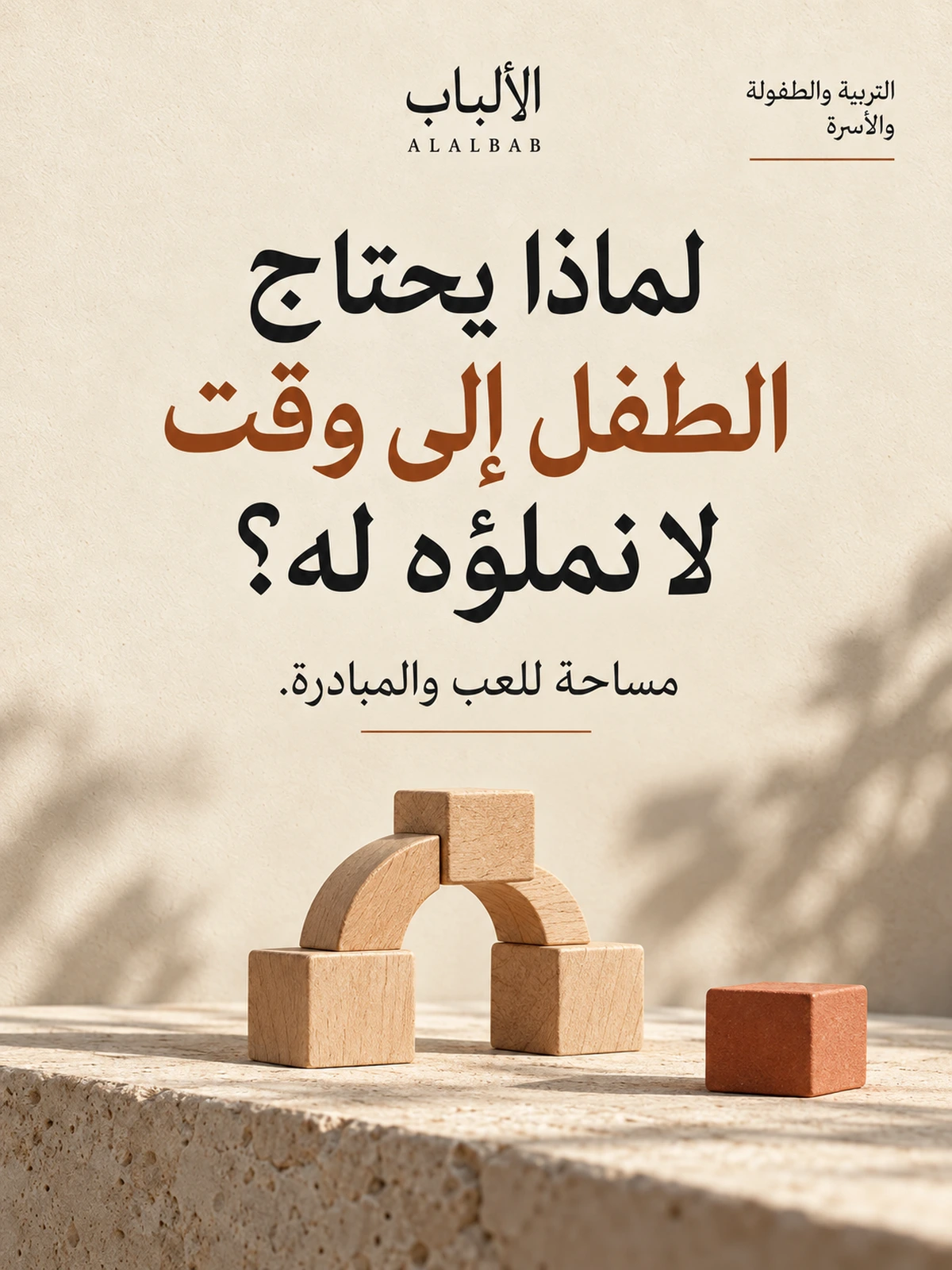
An evening without an activity name
In an imagined scene, a child returns from school, leaves his bag by the door, and asks his mother, “What have we got today?” She scrolls through a little schedule on her phone: training, then a lesson, then unfinished homework. On a day when the slots are empty, the system seems to have malfunctioned. The child stands in the middle of the room and says, “I'm bored.” His mother reaches for her phone to find an activity nearby, then stops. They have an hour whose contents neither knows in advance.
The mother is not inattentive to her son; the schedule itself may express her love. She wants him to learn, find friends, and try things she never had the chance to experience. Nor is the child lazy for not immediately choosing something to do. He has become accustomed to a day arriving with instructions, his task being to move from one doorway to the next. But this hour raises a question different from achievement: when does a child get a share in composing his day, rather than carrying out a day we prepared for him?
The hour might end with a city built from wooden blocks, an old book explored, or a passing conversation that leads to no project. The child may also remain hesitant for a while and need company to begin. We need not turn these possibilities into a promise that every empty space will produce genius. It is enough to notice a simple difference: when the outcome is not predetermined, choice has a place. What would I like to try? What will I do if the idea fails? Am I allowed to change my mind?
This article discusses time we do not fill completely for a child while care and boundaries remain. It proposes no magical number of minutes and does not judge families by the number of courses their children attend. It asks how we can balance what we know matters with what children can discover about themselves only when given the chance to explore. Parenting includes organizing life and recognizing where we should loosen our hold on its details.
Opening questions
- When does a child get a share in composing their day, rather than merely carrying out a schedule we prepared?
- What distinguishes free play from leaving a child without care?
- Does research establish that reducing structured activities improves initiative?
- How do we balance a child's need for company with their right to choose?
1. Who owns the next question?
In a structured activity, an adult usually determines the starting point, steps, and standard of success. The child learns to follow instructions, practice a skill, and respect others' turns. These have their place. In child-led play, part of the task is discovering the task itself. A child may begin by lining up blocks, then make them a train, then decide the track needs a tunnel. The next question does not always come from a coach; it emerges from the problem the play has created.
This distinction helps us examine a busy day without reducing it to a ready-made judgment. One child may love sports training, choose to return, and find ample room for initiative within it. Another may have what we call free time while adults determine the drawing's form, colors, and finishing time. An activity's name alone does not tell us who leads the experience. We can instead ask: Who chooses? Who changes the plan? Can the child try a method we did not suggest?
“Play is not frivolous.”
Reflecting on this educationally, we find that granting time cannot be separated from granting some authority over it. We can set boundaries for space, materials, and safety while leaving the story open. A father can say, “These papers and colors are available; you need me here to use the scissors.” He need not then decide that the drawing must be a tree, the tree green, and the page incomplete until it contains something worth photographing. The framework protects the experience; excessive detail may take it over.
This moment presents adults with a subtle test: tolerating an ordinary result. A child may build something we do not understand, repeat yesterday's game, or leave work unfinished. If we demand an impressive product to accept the time's value, we have reintroduced the examination through another door. We can discuss the experience and ask the child to tidy up without making admiration a condition for deserving the space. Not every childhood hour is an exhibition, nor every attempt a message to an audience.
Time we do not fill also need not mean time alone. A child may choose to play with a sibling or invite us into a story. The question is our position in the relationship: do we join the child's world or replace it with one we consider more useful? A mother can sit as a customer in an imaginary shop without turning every item into an arithmetic exercise. If a natural learning question arises, she can answer it. Flexibility lets knowledge enter when play needs it, rather than making play a permanent wrapper for a hidden lesson.
Consider another imagined example, offered for clarification rather than as a documented event. A child draws a map of a nonexistent neighborhood, placing the sea in the middle of a street. An adult explains that streets do not work that way and redraws the lines. The result is more accurate in one respect, but no longer the map the child wanted to make. The adult could have asked, “How do people cross this sea?” The answer might involve boats, a bridge, or a story unconstrained by real cities' rules. If, however, the task is schoolwork about a real map, accuracy becomes part of it. Understanding an activity's purpose precedes correcting it; otherwise, we treat imagination like an arithmetic mistake.
2. What does research establish, and what remains possible?
Studies offer more precise language than “empty time is good.” In a 2014 study by Jane Barker and colleagues, seventy children aged around six and seven participated; three were excluded from analyses because detailed activity information was unavailable. Researchers collected parents' reports of time use and used tasks measuring aspects of executive function. Less-structured time was associated with better performance on a self-directed task; this was not a randomized experiment establishing causation.
“The correlational nature of our study.”
This qualification is essential: earlier abilities might help a child choose less-structured activities, or unmeasured factors might influence both time use and performance. The research category also extends beyond free play alone. We therefore cannot conclude that structured lessons harm children or derive a time prescription for all ages. The finding offers a question deserving attention, with clear limits on what can be inferred.
Harvard's Center on the Developing Child describes executive function through skills such as planning, focusing attention, and switching tasks. Its guide presents activities for stages from infancy to adolescence, emphasizing practice and adult support. We cannot assume self-management is already fully developed in a child and then blame them for not using it. It is an area for learning and developmentally appropriate assistance. Activity guide.
The American Academy of Pediatrics' 2018 report reviews the value of play with parents and peers, distinguishing free play from guided play, in which children retain initiative while adults prepare the environment or offer supportive questions. It is a clinical report gathering evidence and recommendations, not a single experiment isolating every form of play's effects. It is appropriately read as support for varied experiences, not a declaration that one side has won a competition between play and education.
There remains room for educational reasoning, which should be named as such. If we want children able to choose, it is reasonable to give them real choices on which to practice. This is an argument about designing education, not a laboratory finding establishing that one particular game will produce one particular trait years later. The idea's strength does not need a grand neurological promise, or every moment attached to a hormone or brain region.
Families can learn from this precision in everyday observation. Instead of declaring that a child “became independent” after a week, we can note that they started an activity of their choice, asked for specific help, or returned to an abandoned attempt. These descriptions are closer to what actually happened. The next day may differ because of tiredness or circumstances. Good observation helps us adjust the environment; hasty judgment may turn the child into evidence sought to confirm our favorite idea.
3. Boredom is a possible doorway, not a compulsory virtue
“I'm bored” may contain different requests. A child might want company, not know how to begin, find the available choices unsuitable, or need rest after a full day. We cannot assign it one meaning and then announce a remedy. It helps to pause: Do they want me with them? Are their materials hard to reach? Do they expect everything to be enjoyable from the first instant? A simple question may clarify the answer, without a lecture on boredom's benefits.
Leaving open time may produce a transition quite unlike the romantic image of a child instantly inventing a game. An adult can acknowledge the feeling: “It seems you don't know what to choose right now.” If needed, they can offer a limited start: “Shall we get out some paper or arrange the building blocks?” Offering an entry point does not take over the experience if the child can refuse or change it. Some children need clearer, repeated support; that does not diminish the value of their participation.
The important distinction is between allowing a possibility and imposing an emotional experience. We do not want to place children in boredom as punishment or ignore distress in the name of building toughness. Nor should their ability to entertain themselves become proof of our good parenting. A child asking for connection is not failing at independence. We can offer a short period of fully attentive company, then explain that we will return to our work, with safe arrangements suited to their age and ability.
The home itself needs to be usable to some degree. If every tool is locked away, every surface forbidden, and every movement brings a reprimand, the problem may be the actual options available. A new playroom is unnecessary. A low shelf, age-appropriate materials, and an easy-to-clean space may suffice. This is a practical suggestion to try, not a standard for judging small homes or family budgets. The available space may be a corner of a shared table.
Conversely, not every open period is a deferred project to push toward completion. A child may want to watch rain, look through pictures, or talk without a purpose. We can protect this quiet while fulfilling obligations. When we later ask, “What did you do?” “Nothing important” can be an acceptable answer. The language of our questions may imply that anything without a visible product has no right to exist.
The problem, then, is not using help or ready-made entertainment on any occasion. Family life includes exhausting days, long waits, and conflicting needs. The idea is to avoid making someone else's choice of what should happen the only response to every pause. Gradually, we can broaden the possibilities: company, a shared beginning, a limited choice, or quiet time. We treat boredom as a message requiring understanding, leaving creativity a welcome possibility without requiring the child to prove it.
4. In the light of the Quran and Islamic wisdom
The Quran presents upbringing as a relationship carrying guidance and meaning. God says, recounting Luqman's advice to his son:
TRANSLATION OF THE MEANING · COMPLETE VERSE 31:17“O my dear son, establish prayer, enjoin what is right and forbid what is wrong, and be patient with whatever befalls you. This is a matter of firm resolve[1].Translation notes: [1] For they are enjoined by Allah.Rowwad Translation Center · QuranEnc · v1.0.20.
This verse belongs to counsel on faith, action, ethics, and patience; it is not a text prescribing an amount of play or a way to organize a child's schedule. As educational reflection, we may learn from its address that the son is a person with responsibilities, and that guidance reaches him in words of closeness and care. Applying that meaning to everyday decisions remains human judgment: How do we give him an appropriate role? How do we correct without erasing his participation? We must not equate our judgment with the revealed text.
In a hadith narrated by Anas ibn Malik, we see a scene close to a young child's world:
“O Abu ‘Umayr, what happened to the little bird?”
Anas relates that the Prophet, peace and blessings be upon him, would spend time with them and address his little brother with these words about his bird. The hadith does not set out a modern psychological program; it offers an example of warmth toward a child and attention to what matters to him. We can draw encouragement from it when asking: Do we enter a child's world to see it, or only to correct it? Listening to a toy's story can be a complete act of care even if it ends without an announced lesson.
Compassion remains a measure that should not disappear under the heading of independence. In the context of the Prophet kissing Al-Hasan ibn Ali, he said:
“Whoever shows no mercy will be shown no mercy.”
We therefore propose an approach joining adult presence with space for the child: preserve safety, clarify obligations, respond to the need for affection, then leave some details to their owner. Respecting initiative does not require emotional withdrawal, nor does compassion require doing everything for a child. When families apply this differently, it remains right to distinguish a value's foundation from the means of putting it into practice.
In Arab homes particularly, care may involve serving a child in many details; at the other extreme, seriousness may involve dismissing play. We can calmly reconsider both habits. We ask children to help put away what they used, after allowing them to use it in their own way. We teach respect for those who clean and organize without making domestic help a reason to cancel a child's responsibility or condemn the family. The value we seek is compassionate participation, which can take different forms according to circumstances.
5. A serious objection: aren't activities irreplaceable opportunities?
A father may say, “The club gives my son friends, a safe place, and a coach who knows what they are doing.” A mother may say, “Working hours make structured activities part of childcare, not merely a race for certificates.” This objection deserves serious attention. A good program can offer experiences difficult to provide at home and be something the child loves. Nor is open time available to everyone on equal terms; safety, space, and support are unevenly distributed resources.
We therefore should not measure parenting quality by an empty schedule or assume every family can cancel lessons. It is more useful to consider balance within the reality available. We may be unable to remove an activity but able to reduce instructions during a short interval, leave the bedtime story choice to the child, or let them decide part of a weekend outing. Space is not always a large block of time; it may begin with a decision adults needlessly monopolized.
“Guided play retains the child agency.”
This formulation helps move beyond a stark choice between leaving a child alone and managing every step. An adult can prepare an intentional environment while the child remains a genuine participant. We must, however, honestly ask what participation means: if every answer we disagree with is rejected, the choice is merely formal. There can be nonnegotiable rules concerning harm and rights alongside extensive negotiable details concerning roles, materials, and the story.
Another objection is that some children cannot readily organize their time. Needs and abilities do differ; one expectation for everyone will not address that. One child may benefit from two clear choices, another from a picture showing the options, another from longer initial participation. This article's example is not a diagnostic or developmental assessment tool. When difficulties persist and affect a child's life, their individual needs should be understood with those who know them and are qualified to help.
An objection from the child also deserves a hearing: they may love the lesson we think burdens their day and reject the free time we imagine as a gift. Listening does not mean every wish determines the decision, but it changes how the decision is made. We ask what they eagerly anticipate, what exhausts them, and what they wish to keep. We explain what can change and what family commitments require. Talking about initiative then becomes practicing it rather than imposing it as a slogan.
Finally, this approach cannot work if its entire burden falls on one parent, often the mother. Preparing the environment, monitoring safety, and tidying disorder are real work. Sharing adult responsibilities and involving children appropriately help make the idea sustainable. Families do not need an educational project that increases guilt; they need a small, maintainable adjustment they can review while recognizing the effort they already make.
6. A family experiment that returns some time to its owner
Start with a calm review of one day. With the child, list what happened, not to judge every slot but to see where they chose and where they followed instructions. We may find a long period spent on a beloved activity and a short one whose transition was exhausting. Or the main problem may not be the schedule but our frequent interference in details. This is a description of existing life; it can happen orally without papers, apps, or a new tracking system.
Next, choose a small space of time that can be protected. Tell the child when it starts, its boundaries, and what follows. A clear ending prevents stopping from feeling like a surprise or a punishment for enjoyment. We do not present the period as a proven dose; the family tries what suits it. Some days food, rest, or conversation will matter more, and the arrangement changes. Flexibility is part of care, not proof the plan failed.
Prepare a few safe, age-appropriate materials: paper, suitable drawing tools, large building blocks for younger children, or a picture book. Keep small objects away from children who may swallow them; sharp tools, water, or leaving home should not become independent decisions before necessary supervision is available. Adults decide safety boundaries. What the pieces become within those boundaries can be the child's decision. Separating these kinds of decision makes freedom understandable to everyone.
At the start, try reducing questions that examine performance. Instead of “Why didn't you make this part prettier?” say, “Tell me what you are making,” if the child wants to talk. It may be best not to interrupt at all. If they request help, ask which part needs it, help there, and see whether they want to finish the rest. If invited to participate, join without assuming you are being asked to lead. Accepting a small role is useful practice for adults too.
When siblings play, leave room for taking turns and negotiating, but do not leave a child exposed to harm in the name of learning. Intervene to stop hitting or insults, then help everyone explain what they want. Not every disagreement needs a winner and loser. Reframing may suffice: “You both want the same piece now; what arrangement is possible?” They may not agree and may need separate materials or an end to the activity. A disagreement does not make the experience a failure.
Similar opportunities arise while traveling. Give a child a limited, age-appropriate decision: Which book will they take? Which lightweight game do they want to pack? Which of two available places should come first? Part of a safe outing can be left open for stopping at what interests them. This does not mean unsupervised movement in an unfamiliar city or handing over decisions about costs and schedules. The child shares some details within responsibilities adults retain.
The experience includes responsibility for closing it. Children help gather what they used, with age-appropriate assistance. Establishing this step beforehand helps; expected mess should not become an excuse to forbid play entirely. If cleaning becomes exhausting, reduce the quantity of materials or confine their location. We adjust the environment rather than ask everyone to bear an unsuitable burden. The freedom discussed here coexists with others' rights to the home's space and comfort.
One easily overlooked detail is how we document play. We may want to photograph every structure and send every drawing to others; sometimes that is enjoyable sharing. But we can also let a whole experience pass without a camera or public comment. Ask whether the child wants to keep their work, and accept their dismantling it to begin something else. This is time for an experience, not an assignment to produce family content. If they enthusiastically show us something, respond with interest in what they did, without ranking siblings by talent or turning admiration into an expectation they must meet every time.
It may help children to see adults using open time too: repairing something simple, reading, drawing without expertise, or caring for a plant. No staged educational scene is needed; we can share ordinary life and honestly say we do not yet know how the attempt will end. This is a suggestion about everyday example, not a claim that imitation is guaranteed. It poses a fair question to us: do we allow ourselves ordinary experimentation, or ask children alone to find enjoyment outside constant direction while filling every pause in our own day with a ready-made stimulus?
After a few days, review the experiment without grading the child. Were the choices understandable? Was longer companionship needed? Were the materials suitable? Did we intervene because of danger or because we disliked the result? Keep what helped and change what faltered. Do not compare siblings' speed of starting or quality of output. The family's preferred open time may turn out to be shared conversation or a repeated simple game. Life need not resemble an ideal photograph to contain room for initiative.
Conclusion: leaving a line for the child to write
The child in the opening scene may remain hesitant before the open hour, and his mother may need to resist offering ten ideas in succession. They can begin together, after which she leaves him a question she has not answered on his behalf. This guarantees neither greater creativity than other children nor proof that his previous day was wrong. It is an attempt to offer an experience not fully available when every stretch of time arrives with all its instructions.
We want children to learn skills, respect commitments, and find guidance. We also want them to discover what they love, try decisions they can revise, and know that companionship need not entail constant management. Among these aims, each family can seek its own balance, learning from research without exaggerating its promises and from values without turning human judgment into a command binding everyone.
Perhaps the question worth taking home is simple: What detail can I leave to my child today while preserving safety and care? Answering does not require emptying life of structure. It requires at least one line children can write themselves, with us nearby when they want to read it to us.
Questions for reflection
- What small decision can my child make today within safe boundaries?
- When do I intervene to protect my child, and when because I dislike the result?
- Which activity does my child truly enjoy, and which needs reconsideration?
- How can we share caregiving and tidying responsibilities so this space continues without exhausting anyone?