

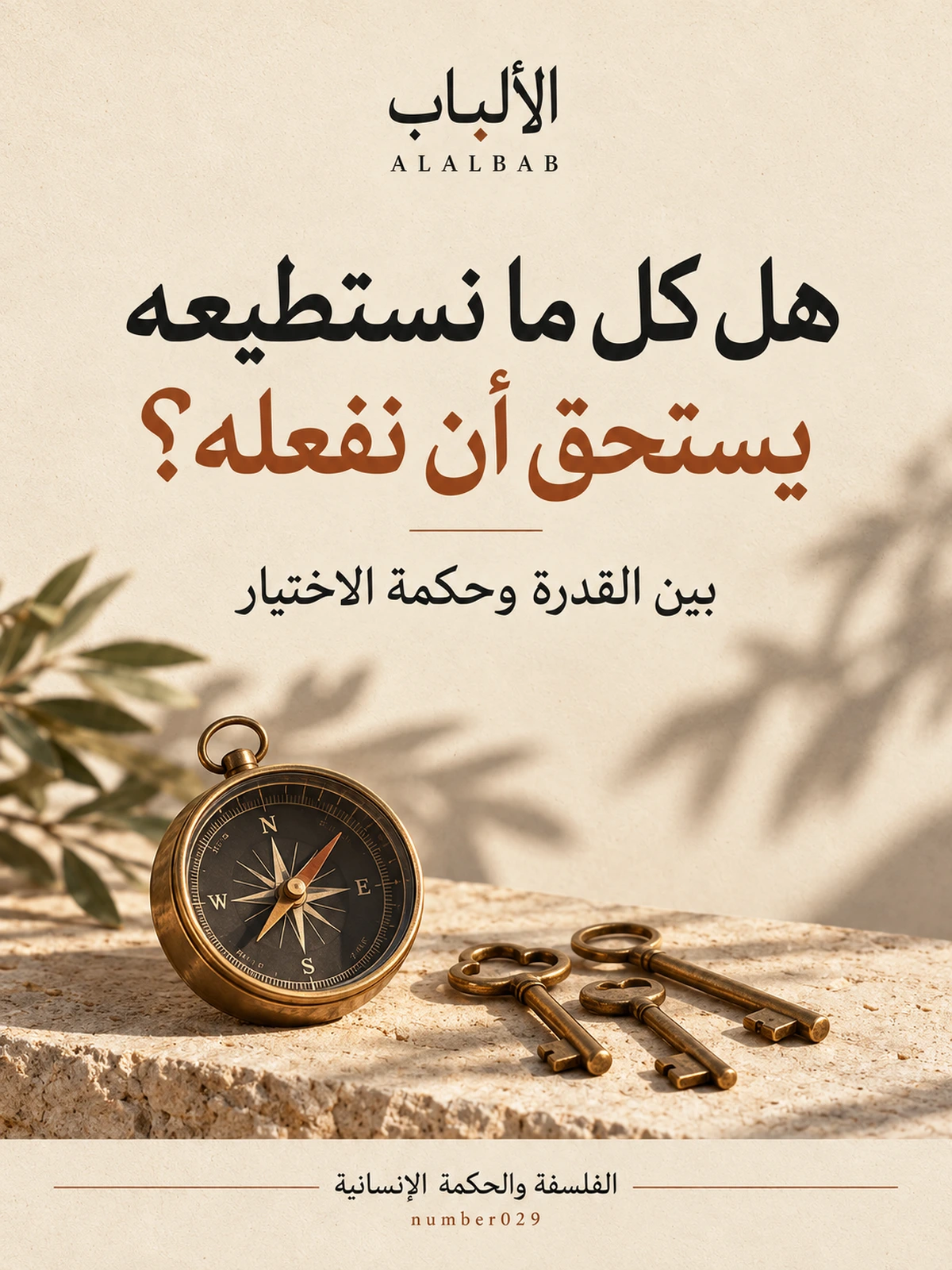
The Key Does Not Choose the Door
In an imagined scene, a man returns home with three new opportunities on his phone: a course he can enroll in, a side project he can begin, and an invitation to a discussion he can join. None seems bad. He opens his calendar to find room, then realizes he has not yet asked why he wants them. The sentence driving him toward each was simple: I can do that. But it did not answer the question he would face once the week was full: is this what I wanted to give my days to?
The problem is not only a shortage of possibilities. We may have the means without a purpose, or the skill to reply without a good reason to enter an argument. Ability opens a door but does not choose the path for us. The distance between what is possible and what is worthwhile is this article's subject: philosophical and ethical reflection, not a psychological test or a study claiming to measure every busy person's motives.
The idea does not call for a small life afraid of experimentation. It asks what kind of freedom we want: is the ability to accept every opportunity enough, or do we also need the ability to leave some aside? Leaving something can be responsible, or an escape needing examination. We cannot distinguish them from “yes” or “no” alone, but from what each protects and what it loses.
- When do we confuse possessing the means with having a purpose?
- What do we lose by accepting something good at the wrong time?
- How do we distinguish wise choice from fear disguised as wisdom?
- Must every beneficial act produce a measurable return?
1. The Question of Ability and the Question of Value
“Can I?” examines resources, skills, and time. “Is it worthwhile?” examines purpose, obligations, and effects. The first answer may be yes and the second no. I can write a harsh comment that is difficult to answer, but skill does not make it fair. I can buy another object, but being able to pay tells me nothing about what it will add to my life.
The reverse can also occur: we know an act's value but lack its conditions now. Someone wanting to help a relative may first need to organize their capacity, rather than accuse themselves of failing merely because their wish exceeds their energy. Glorifying willpower or competence alone is insufficient. A good decision needs an act's meaning to meet the conditions that make it possible, or a reasonable step bringing them closer.
“Be keen on what benefits you, seek God's help, and do not give up.”
This guidance appears in a hadith bringing together strength, seeking God's help, and responding to what is decreed. We do not reduce it to advice for increasing output or confine benefit to individual profit. The article's practical reflection is that eagerness should be preceded by a question about what we are eager for. We may devote great effort to a skillfully performed act, then discover we never reviewed its direction.
This matters in small acts before major decisions. Are we replying to clarify a matter or embarrass its speaker? Are we learning a skill because of a need we see, or because we cannot bear missing what others learn? These questions give no magical window into our intentions, but make the reason open to examination instead of leaving speed as the only argument.
2. Every Agreement Consumes Something Its Price Does Not Reveal
An invitation may be free, a course available, and a project inexpensive. But the time we give them is no longer available for something else at that same moment. This is an observation about the day's limits, not an invitation to turn life into commercial accounting. An hour with a child or friend is not a low-return item to discard; it may be precisely what we want to protect the day for.
Imagine someone agreeing to an extra activity because they can do it in the evening. After a week, they discover they have lost not only sleep but also begun rushing through other meetings. This is an imagined example, not a claim that every extra activity causes this result. It reveals a question the original agreement missed: do I count only execution time, or also preparation, recovery, and what will be displaced?
“There are two blessings in which many people lose out: health and free time.”
Calling free time a blessing does not require filling it without interruption. Caring for health does not fit treating it as an inexhaustible balance. We read the hadith as a reminder of the value of what is available to us; arranging a day remains a judgment varying with circumstances. Keeping an hour free may prepare for an urgent responsibility, provide rest, or leave room for unhurried reading.
This discussion must not become blame directed at people with few choices. Someone working long hours to meet family needs does not stand before a shelf of equivalent opportunities. Choosing begins with what can actually change, without turning social constraints into personal failure. The available step may be rearranging one request, negotiating a time, or asking others to share a load that should not fall on one person alone.
3. Enough Knowledge Before Confident Action
Execution is sometimes easier than understanding what we are doing. We can repost news in a moment, offer a decisive opinion on a subject we do not understand, or use a tool producing an apparently complete result. The problem is not inactivity but moving from possibility to action without stopping to verify. An available button does not give us knowledge of the consequences of pressing it.
TRANSLATION OF THE MEANING · COMPLETE VERSE 17:36Do not follow[1] that of which you have no knowledge. Indeed, the hearing, the sight, and the heart, all of them will be called to account.Translation notes: [1] i.e., do not say or assume.Rowwad Translation Center · QuranEnc · v1.0.20
The verse concerns responsibility for hearing, sight, and the heart and appears among ethical guidance. Applying it to circulating news and digital opinion is a contemporary reading of the principle, not a claim that every uncertainty prevents action. Life does not require complete knowledge of every result, which is unavailable, but knowledge proportionate to what a decision may entail.
A small reversible experiment differs from a decision affecting others' rights or reputations. We can try arranging a desk differently and change it, but publicly accusing someone is not a neutral personal experiment. The broader an act's effects and the less repairable they are, the more we need verification and a hearing for those affected.
Useful confidence can say, “This is what I know, and this is what I have not yet checked.” The sentence does not deprive us of ability; it locates it. The most valuable contribution to a gathering may be a well-formed question or referring people to someone who knows, rather than using eloquence to hide the limits of knowledge. Humility here works inside the decision, not as verbal decoration added after certainty.
4. In the Light of the Quran and Islamic Wisdom
Among believers' qualities, Surah Al-Mu'minun describes an attitude toward idle speech:
TRANSLATION OF THE MEANING · COMPLETE VERSE 23:3and those who turn away from all that is vain,Rowwad Translation Center · QuranEnc · v1.0.20
The verse does not appoint us judges over every laugh or hobby, or give this article the right to classify what it dislikes as idle speech. The description appears within a context of faith including prayer, charity, and trusts. Our reflection concerns the possibility that turning away is a positive act: a person need not respond to every summons simply because they can.
Surah Al-Asr places action in a setting broader than individual achievement:
TRANSLATION OF THE MEANING · COMPLETE VERSE 103:3except those who believe and do righteous deeds, and exhort one another to the truth and exhort one another to patience.Rowwad Translation Center · QuranEnc · v1.0.20
This is the exception following the oath by time and the statement of human loss. We do not reduce the surah to time management: it brings together faith, righteous action, and mutual encouragement in truth and patience. The number of completed tasks alone therefore cannot measure a day's value. There may be much activity without truthfulness, while our most important act may be fairness that never appears on a task list.
From these texts, the article proposes a reflective measure: benefit inseparable from responsibility, action inseparable from knowledge, and restraint inseparable from honesty with oneself. This is a considered ethical synthesis, not a religious ruling on individual acts. It does not replace consulting qualified specialists when a decision involves rights or rulings requiring particular knowledge.
5. A Serious Objection: Will We Keep Thinking Instead of Living?
The objection is strong. People can use the question of usefulness to delay every beginning, demanding certainty a decision never needed. Someone who refuses to learn until assured it will benefit them for life may never learn anything. Some meanings emerge only through experience: we discover love for drawing by drawing, not by completing a report about its usefulness.
We therefore propose no philosophical checkpoint before every daily act. We distinguish a limited trial from a long commitment, permissible play from frivolity harming others' rights. We can try something because we are curious or because it is beautiful and enjoyable. Pleasure, affection, and beauty are human values; they need not always disguise themselves as productivity to deserve a place.
Before a small trial, the better question may be: can I make room for this without compromising existing commitments? Afterward: what did I learn about myself and the activity? A major commitment requires more detail about costs, beneficiaries, and alternatives. Review then fits the scale of the decision instead of becoming a permanent excuse for inaction.
Inaction is not always neutral either. Delaying a word of fairness or feasible help may leave effects that saying we were reflecting cannot erase. Wise choice accepts scrutiny of restraint as well as initiative. When duty is clear and capacity available, the real question may be: why am I hiding behind more thought?
6. Practical Applications: Write a Reason Before Filling a Time Slot
Choose one new decision and write the reason for accepting it in an understandable sentence. Do not settle for “an excellent opportunity” or “I can do it.” Say, for instance, “I want this course to learn a skill I will use in a specific project,” or “I accept this visit because our relationship deserves time I have not given it.” The reason may simply be that the activity makes you happy, provided it is honest and fits your obligations.
Then ask what it will displace and who will bear its cost with you. Will you postpone a promise? Does the decision need the agreement of someone sharing the time or money? Its effects do not become purely personal because the decision is yours. Next, identify what knowledge you lack and whether you can obtain it before committing or through a limited trial with clear boundaries.
If a trial is suitable, give it a review date rather than an open-ended promise. Try an activity for weeks, then evaluate its place in your life without treating adjustment as defeat. If you decline, do so clearly and respectfully. You need not belittle the opportunity to justify leaving it; being good but incompatible with what you can carry now is enough.
Families can make a simple application: when choosing a child's activity, ask not only whether the family schedule allows it, but what the child wants, whether they need time for unstructured play, and who will handle transport and follow-up. These are proposed educational questions, not a research prescription guaranteeing an outcome. The aim is for children to learn that being able to add something does not make adding it obligatory.
Conclusion: A Door We Choose Consciously
At the end of the imagined scene, the man does not erase every opportunity. He chooses one, postpones another, and declines the third. Not using all his abilities in one week has not made him less capable. He has become clearer about what he wants to give his time to and what he should preserve for those to whom he has already committed.
Freedom may lie in possessing many keys, but it also needs a compass. A key does not become worthless by staying in our pocket; we may need it tomorrow. Today, it is enough to know why we open this door, with what knowledge we enter, whom we bring with us, and what we leave behind.
Questions That Stay with Us
- What have you recently agreed to because you could, without specifying why you wanted it?
- Which commitment deserves time protected from new opportunities?
- When was your restraint wise, and when was it fear needing to be faced?
- What small experiment deserves to begin without waiting for complete certainty?